

TL;DR
- SGAI replaces per-viewer manifest stitching with one shared manifest, deciding each ad in real time at the moment of playback.
- RTBF and its partners took SGAI live across every channel for FIFA World Cup 2026, one of the first deployments anywhere to run at this scale.
- Shared, real-time data across Bitmovin, Red Bee Media, and Ad Insertion Platform (AIP) gave the whole partner ecosystem a live feedback loop all tournament long.
- The data also surfaced a platform gap, with Android TV and iOS generating more ad impressions per play than web.
- Across the tournament, the workflow handled 50 million+ plays and 80 million+ ad impressions, with 90% to 98% successful ad plays and sub-1-second startup throughout.
—–
A live audience of millions and over six weeks of World Cup football, back to back. Launched with RTBF, this deployment got the kind of real-world test most new ad architectures rarely see. It generated real-world data on viewer behavior, ad decisions, and how the architecture held up under live broadcast pressure. Every one of those viewers, streaming live or catching up later, needed a compliant, relevant ad served in real time, under advertising rules that don’t bend for a tournament schedule.
In this piece, we’ll go into how the deployment held up in practice, and what the data revealed once six weeks of live football put the architecture to the test. Let’s get into it.
What SGAI Actually Is
Server-Guided Ad Insertion, or SGAI, enables an ad to be selected and played dynamically when the viewer reaches an ad opportunity, rather than baking that decision into a viewer-specific manifest ahead of time. The distinction that matters most is the manifest. Every viewer watches from the same shared manifest, with SCTE-35 markers signaling where ad breaks can occur, rather than each viewer getting a unique, pre-stitched manifest built just for them. The server side, AdBlendr, orchestrates the ad decision, applying business rules and routing the request to the right ad servers in real time. The player side keeps execution control, with Bitmovin’s Player requesting the selected ad pod and handling playback at the moment it is needed. That split, server-guided decisioning paired with player-side execution, is what lets the same shared manifest serve a viewer watching live and a viewer rewinding to an earlier point, without a new manifest built for either one.
RTBF’s previous SSAI setup relied on stitching a distinct manifest for each viewer to insert ads, an approach that works for straightforward linear delivery but grows complex fast once DVR rewinds and compliance rules multiply the number of viewer-specific scenarios. SGAI’s shared-manifest, server-guided model gives RTBF more flexibility and precision as scale and compliance demands grow.
No per-viewer manifest to pre-build. Just a shared manifest and a decision made at the moment it’s needed.

How SSAI’s per-viewer manifests compare to SGAI’s shared manifest with real-time, player-side ad decisions.
Putting SGAI to a Real-World Test
The FIFA World Cup does not move its kickoff time because a broadcaster’s ad workflow is not ready.
RTBF’s new Server-Guided Ad Insertion (SGAI) deployment, built with Bitmovin and its technology partners, got a different kind of proving ground, going live across every channel for the FIFA World Cup in front of a massive live audience, more than 50 million video plays across the tournament.
That coalition brought together five partners, each with a distinct role.
- RMB, the ad sales house
- Red Bee Media, the systems integrator
- Dotscreen, the application developer
- Ad Insertion Platform (AIP), the ad decisioning specialist
- Bitmovin, the player and Observability provider
The bulk of RTBF’s audience watched matches live, meaning every ad request had to be decided and served in real time, at the exact moment a huge share of the country streamed the same match at once. On top of that live volume, RTBF also had a significant catch-up audience, with many matches airing late at night in Belgium.
Previously, DVR viewers represented inventory RTBF could not effectively monetize. With SGAI, those same viewers could be served relevant, compliant ads wherever they entered the stream, turning catch-up viewing into a new source of monetizable inventory, a shift that mattered even more during a tournament where so much viewing happened after the final whistle.
What the Workflow Had to Do in Real Time
Every ad request during the tournament ran through the same chain, end to end.
- Red Bee Media prepared RTBF’s live and VOD streams with SCTE-35 markers
- AIP’s AdBlendr platform applied RTBF’s routing and business rules, matching each request against ad inventory in real time
- Bitmovin’s Player played the selected ad pod and enforced playback rules in real time across every major platform RTBF supports
- Dotscreen’s application layer carried it across every device RTBF supports
Layered under all of it were compliance rules RTBF cannot bend on.
- No ads on children’s programming, enforced through dynamic category suppression
- No repeated breaks in a single session
- Strict frequency limits, enforced dynamically rather than encoded into a manifest ahead of time
That same chain of decisions ran for every one of the more than 80 million ad impressions served across the tournament, match after match. None of that logic had been proven at full tournament scale before kickoff.
Holding Up Under Six Weeks of Live Football
Across six straight weeks of live football, more than 80 million ad impressions later, the workflow held. The same decision, whether to serve an ad, which one, and how to keep it compliant, got made correctly every time, for every viewer watching live and every viewer catching up hours later.
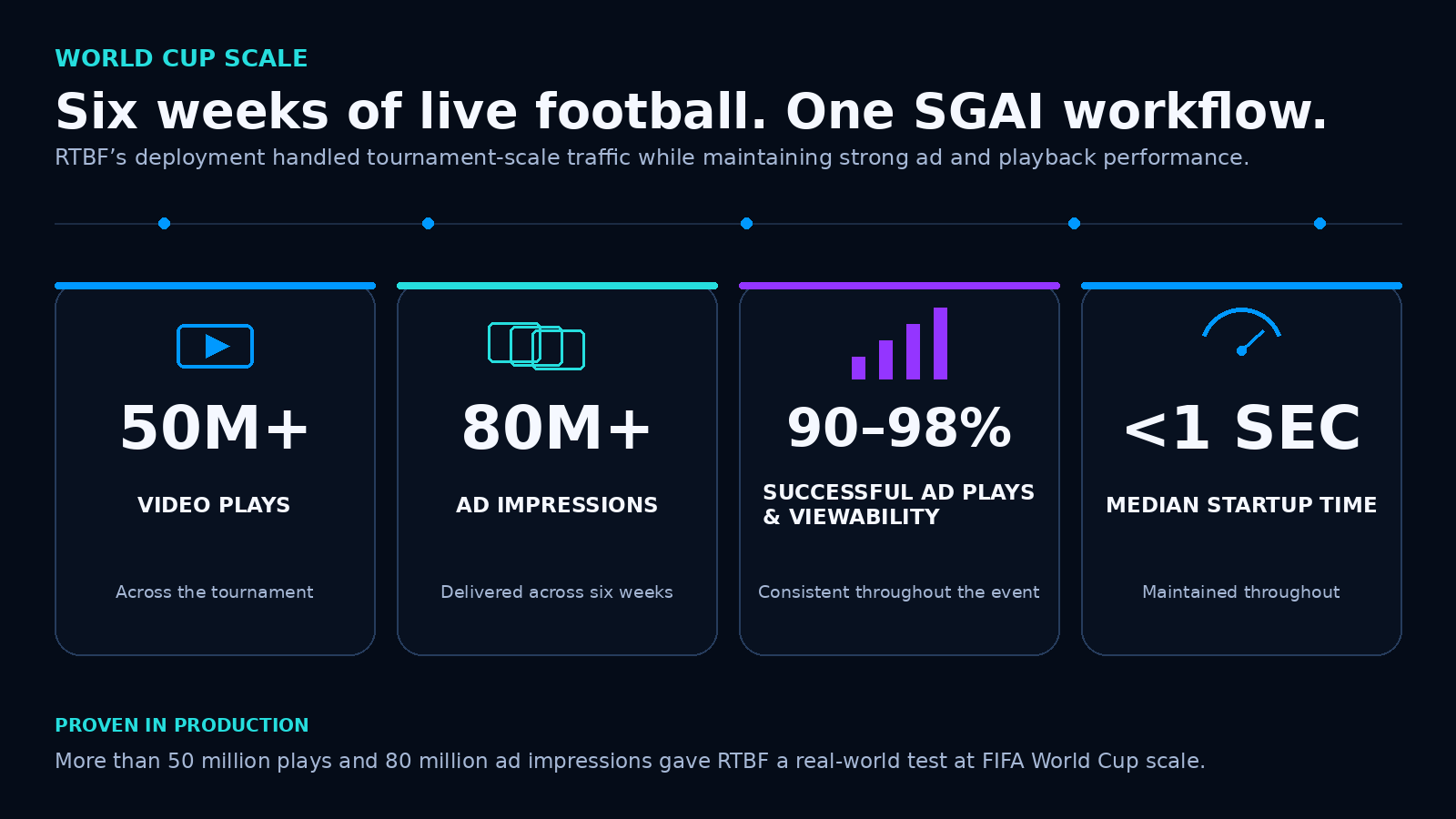
Headline results across the full FIFA World Cup 2026 tournament window.
Bitmovin’s Player kept executing ad playback and enforcing rules throughout the tournament, while Bitmovin’s Observability solution gave RTBF’s team real-time visibility into performance as events happened, but that visibility only mattered because the rest of the ecosystem was built to act on it.
- Data flowed upstream to Red Bee Media and AIP, letting both partners tune infrastructure to live viewer load as the tournament unfolded
- RMB used that same live picture to back its advertiser guarantees with hard data instead of estimates
- Ad requests climbed in step with kickoff on every match day, and the pattern held from the opening whistle through the final one
- Successful ad plays and viewability both stayed in the 90% to 98% range, with ad completion around 90%, without any part of the chain buckling
- Median startup time stayed under 1 second throughout
The Platform Gap in Ad Density
Web carried the largest share of raw traffic by far. It was not, however, where each play generated the most ad impressions.
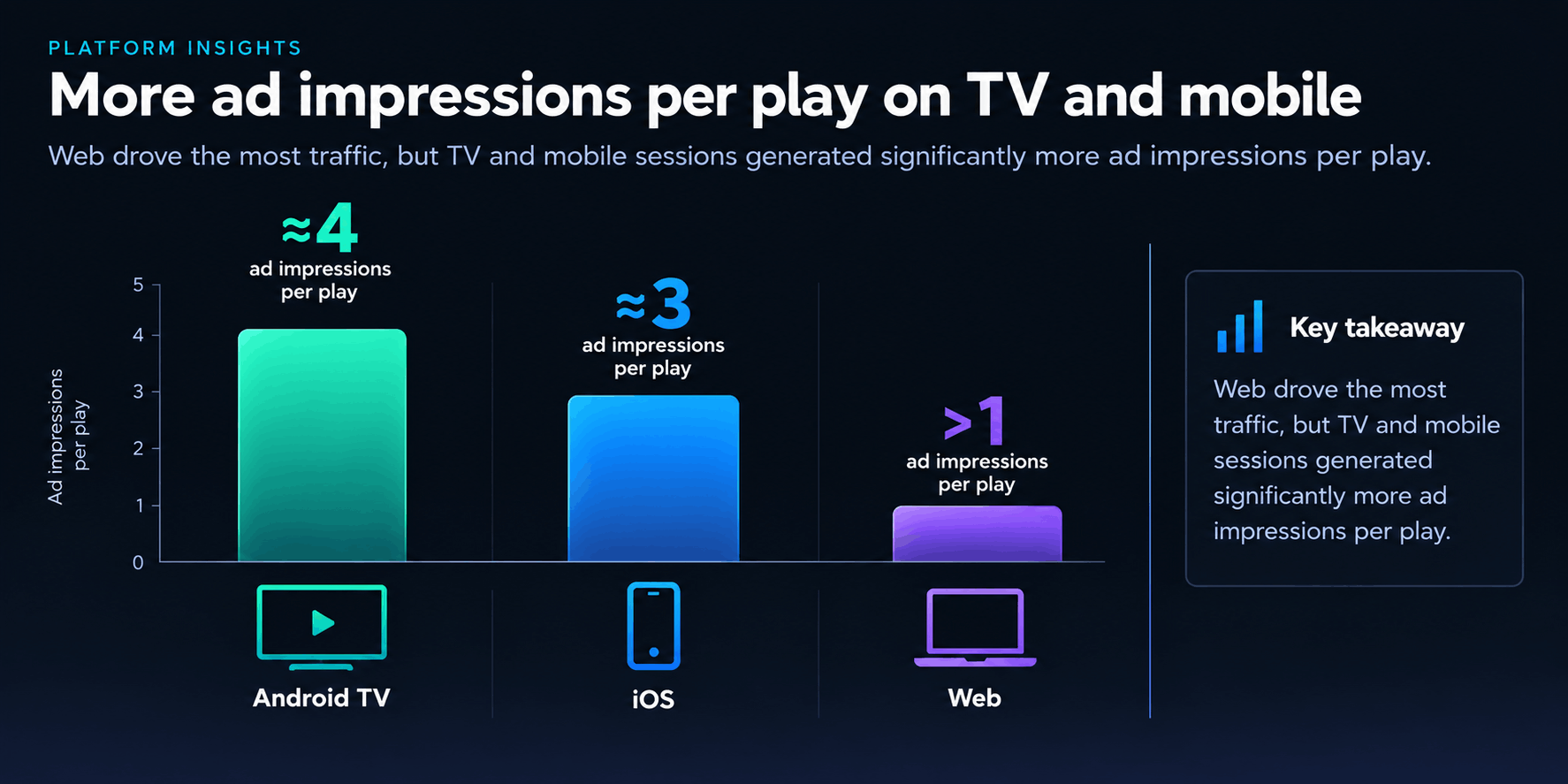
Ad impressions per play by platform, Android TV and iOS generated far more than web.
Android TV sessions averaged close to 4 ad impressions per play and iOS around 3, compared with just over 1 on web. The pattern suggests viewing behavior may be a major factor, big-screen and mobile viewers may be settling into longer, fuller match sessions rather than dipping in and out, which would mean more SGAI ad breaks triggered per session on those platforms. Belgium accounted for over 90% of all ad impressions, exactly as expected for a national broadcaster, with meaningful cross-border reach into France, Spain, and Germany.
It is the kind of detail that reshapes where a broadcaster focuses monetization effort next.
Making SGAI Work Across a Fragmented Device Ecosystem
Delivering SGAI consistently across RTBF’s application landscape was as demanding as the server-side workflow itself. Dotscreen integrated the SGAI workflow into RTBF’s existing applications across Web, iOS, Android, Smart TVs, Android TV, Apple TV, and operator set-top boxes, while simultaneously adding Amazon Fire TV and Hisense/VIDAA to the platform portfolio, maintaining a consistent integration regardless of platform-specific constraints.
That integration preserved every aspect of the existing viewing experience, from playback and DRM to navigation and content discovery, allowing RTBF to introduce a new advertising architecture without compromising the reliability of its streaming services during one of the world’s largest live sporting events.
A Blueprint Beyond One Broadcaster
Few broadcasters anywhere have run SGAI this big before, making RTBF’s tournament an early, public answer to a question the rest of the industry is still asking, whether an architecture like this actually holds up at real scale.
Many of the constraints RTBF had to address will be familiar to public broadcasters across Europe. Because the deployment runs on open HLS interstitial standards rather than proprietary manifest logic, it isn’t locked to one broadcaster or one tournament. RTBF is already carrying it into its everyday programming, not just World Cup coverage.
The full breakdown of RTBF’s results, along with a quote from RTBF on the impact of the deployment, is available in
Get Involved
Broadcasters evaluating an SGAI migration for their next major live event can get in touch with the Bitmovin team to talk through the architecture.