
TL;DR
- AI video super resolution enhances lower-resolution video to higher resolutions using machine learning models trained to reconstruct details that traditional upscaling cannot recover
- Unlike conventional scaling techniques, AI-based approaches infer missing detail, improving sharpness, texture fidelity, and perceptual quality while reducing artifacts such as blur and noise
- AI remastering can modernize legacy video libraries, enabling content owners to repurpose archival assets for premium OTT, UHD, and large-screen experiences without costly re-shoots
- Super resolution integrates into encoding and streaming workflows, allowing improved quality at lower bitrates and contributing to bandwidth efficiency and enhanced QoE
- AI-driven enhancement supports monetization and sustainability goals, extending content lifespan, increasing perceived value, and optimizing delivery efficiency across devices and networks
Table of Contents
AI has been the hot buzz word in tech the past couple of years and we’re starting to see more and more practical applications for video emerging from the hype, like automatic closed-captioning and language translation, automated descriptions and summaries, and AI video Super Resolution upscaling. Bitmovin has especially focused on how AI can provide value for our customers, releasing our AI Analytics Session Interpreter earlier this year and we’re looking closer at several other areas of the end-to-end video workflow.
We’re very proud of how our encoder maintains the visual quality of the source files, while significantly reducing the amount of data used, but now we’re exploring how we can actually improve on the quality of the source file for older and standard definition content. Super Resolution implementations have come a long way in the past few years and have the potential to give older content new life and make it look amazing on Ultra-High Definition screens. Keep reading to learn about Bitmovin’s progress and results.
What is video Super Resolution and how does it work?
Super Resolution refers to the process of enhancing the quality or increasing the resolution of an image or video beyond its original resolution. The original methods of upscaling images and video involved upsampling by using mathematical functions like bilinear and bicubic interpolation to predict new data points in between sampled data points. Some techniques used multiple lower-resolution images or video frames to create a composite higher resolution image or frame. Now AI and machine learning (ML) based methods involve training deep neural networks (DNNs) with large libraries of low and high-resolution image pairs. The networks learn to map the differences between the pairs, and after enough training they are able to accurately generate a high-resolution image from a lower-resolution one.
Bitmovin’s AI video Super Resolution exploration and testing
Super Resolution upscaling is something that Bitmovin has been investigating and testing with customers for several years now. We published a 3-part deep dive back in 2020 that goes into detail about the principles behind Super Resolution, how it can be incorporated into video workflows and the practical applications and results. We won’t fully rehash those posts here, so check them out if you’re interested in the details. But one of the conclusions we came to back then, was that Super Resolution was an especially well-suited application for machine learning techniques. This is even more true now, as GPUs have gotten exponentially more powerful over the past 4 years, while becoming more affordable and accessible as cloud resources.

ATHENA Super Resolution research
Bitmovin’s ATHENA research lab partner has also been looking into various AI video Super Resolution approaches. In a proposed method called DeepStream, they demonstrated how a DNN enhancement-layer could be included with a stream to perform Super Resolution upscaling on playback devices with capable GPUs. The results showed this method could save ~35% bitrate while delivering equivalent quality. See this link for more detail.

Other Super Resolution techniques the ATHENA team has looked at involve upscaling on mobile devices that typically can’t take advantage of DNNs due to lack of processing power and power consumption/battery concerns. Lightweight Super Resolution networks specifically tailored for mobile devices like LiDeR and SR-ABR Net have shown positive early outcomes and performance.
AI-powered video enhancement with Bitmovin partner Pixop
Bitmovin partner Pixop specializes in AI and ML video enhancement and upscaling. They’re also cloud native and fellow members of NVIDIA’s Inception Startup Program. They offer several AI-powered services and filters including restoration, Super Resolution upscaling, denoising, deinterlacing, film grain and frame rate conversion that automate tedious processes that used to be painstaking and time consuming. We’ve found them to be very complementary to Bitmovin’s VOD Encoding and have begun trials with Bitmovin customers.
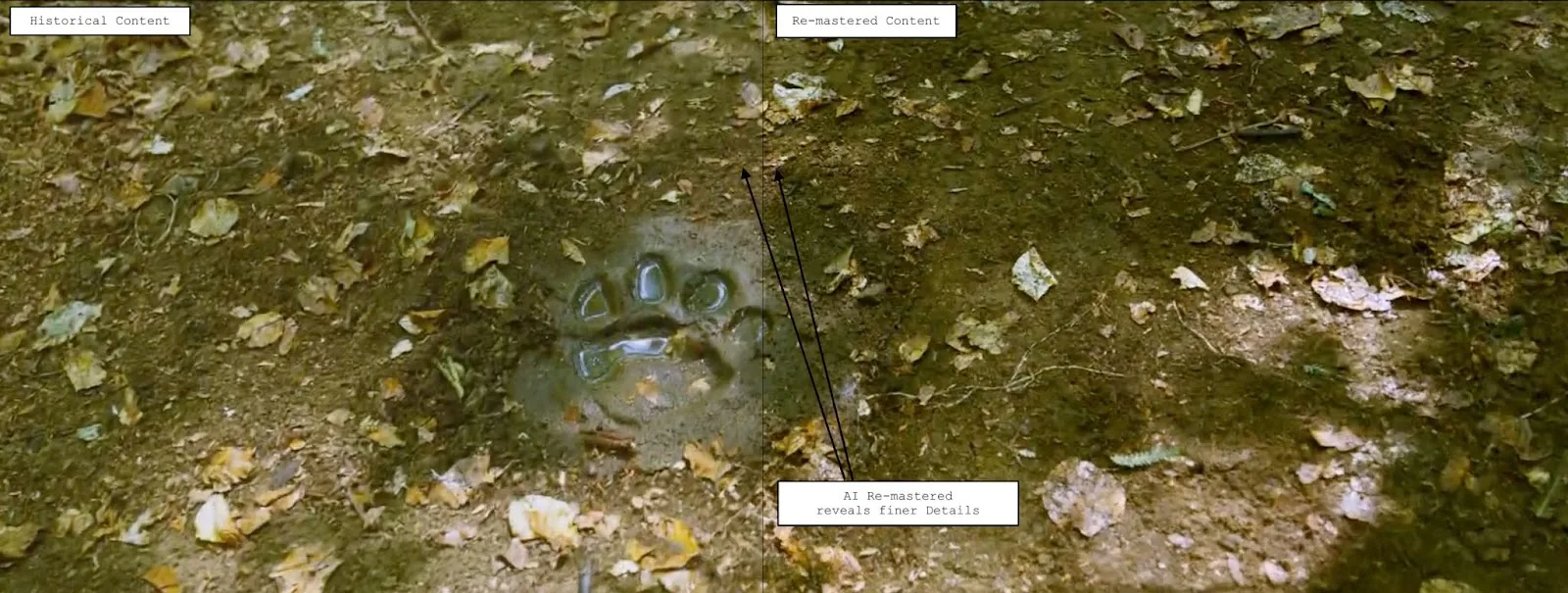
One application we’re exploring is digital remastering of historic content. We’ve been able to take lower resolution, grainy and generally lower quality content (by today’s standards) through Pixop’s upscaling and restoration, with promising results. The encoded output was not only a higher resolution, but also the application of cropping, graining and color correction resulted in a visually more appealing result, allowing our customer to re-monetize their aged content. The image below shows a side-by-side comparison of remastered content with finer details.
Interested in giving your older content new life with the power of AI video Super Resolution? Get in touch here.
FAQs
What is AI video super resolution?
AI video super resolution is a machine learning-based technique that enhances video from a lower resolution to a higher one by reconstructing fine details that were not present in the original source.
Does AI super resolution increase bitrate?
Not necessarily. It can enable comparable visual quality at lower bitrates, improving compression efficiency and reducing delivery costs.
Is AI super resolution suitable for live streaming?
While traditionally applied to VOD and remastering workflows, advancements are making real-time or near-real-time AI enhancement increasingly viable for live use cases.
Does AI super resolution work across all devices?
The enhanced content can be delivered to any device capable of decoding the target resolution, such as 4K TVs, mobile devices, and OTT platforms.
What is the difference between video remastering and super resolution?
Super resolution specifically focuses on increasing spatial resolution. Remastering is broader and may include denoising, color correction, artifact removal, and overall visual restoration.
Related Links
Blog: Super Resolution Tech Deep Dive Part 1
Blog: Super Resolution Tech Deep Dive Part 2
Blog: Super Resolution Tech Deep Dive Part 3
Blog: AI Video Research
ATHENA research lab – Super Resolution projects and publications