
Two events happened in Amsterdam last week and the two were more closely related than many people realize. The two events were:
- The video tech industry’s biggest European event: IBC Show
- AGNTCon + MCPCon Europe, a major event for the Model Context Protocol (MCP) community
The first event was attended by publishers representing some of the most valuable media content in the world, and secondly the people who are building the next generation of protocols enabling AI assistants to connect to external systems.
Here’s why we believe these two groups should be working together.
2027: the living room starts in a chat window
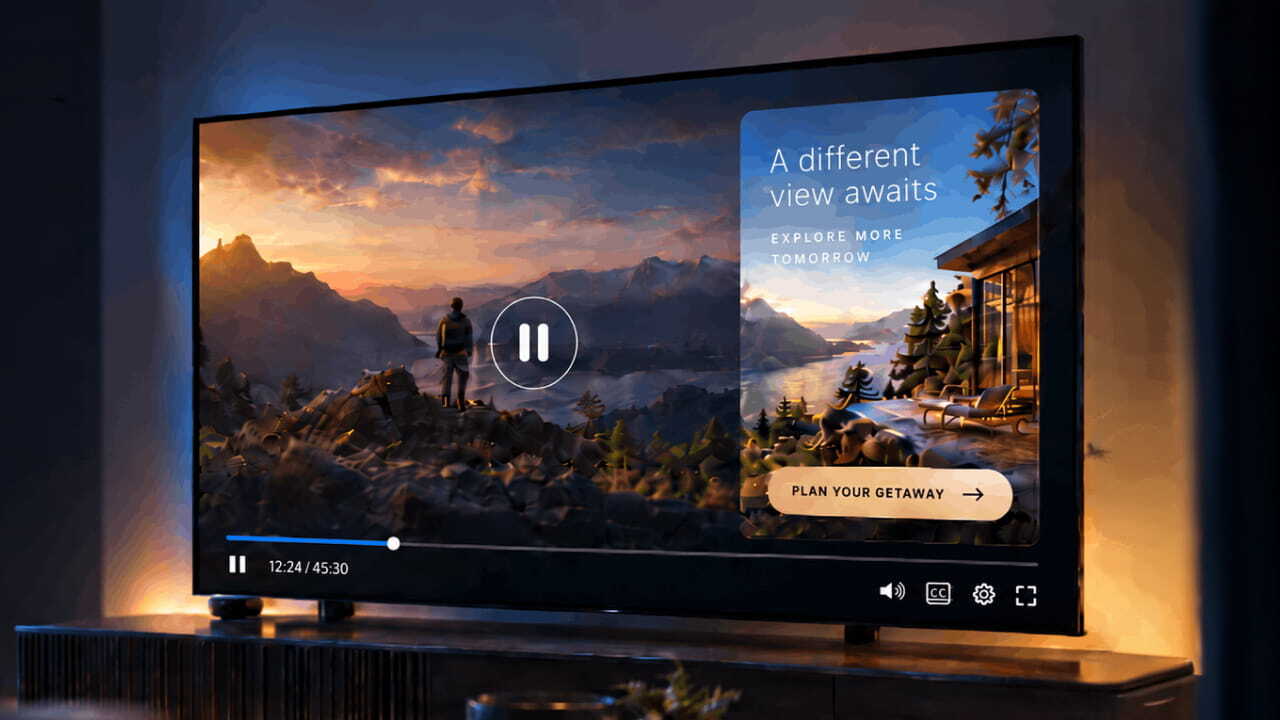
It’s a Tuesday evening, a person sits down on their sofa and opens ChatGPT, not a TV app. They ask what they should watch. The recommendation they get is based on their taste because the assistant has years of context on what they like, what they have already seen and how much time they have before bed. The streaming service’s own app loads directly inside the conversation. It’s branded and signed in, and it already knows what they pay for. They press play, and the video casts directly on the TV across the room.
Wednesday morning, a football fan asks Claude what happened in last night’s matches. Claude gives them the results and the story of the games, and the broadcaster they subscribe to loads clips of the goals straight into the answer.
Once you see the shape of it, this model applies to most video. News, where a summary of the day arrives with clips from the outlets that person subscribes to, playing in a video player that the outlet controls and brands. A recipe where you can watch an instructor assembling the ingredients alongside a description of the recipe. A DIY question answered with a 30 second clip of someone using the tool. Product reviews, where a table compares 2 products then a video demonstrates key features with the assistant simply playing it for you.
The common thread is that the video arrives where the question was asked and it can move from the phone to the television as needed. Contrast that with today’s experience: you find your answer in an AI assistant, then open a browser or an app to watch videos related to the answer. The AI assistant may include a direct link to where you can watch a relevant video, but in our experience that’s often not the case.
Another change is fueling this vision of the near future: AI answers are replacing publisher traffic. Pew Research found that when Google shows an AI summary, users click through to a website half as often as when no summary appears. Microsoft’s own data goes further, showing that Bing’s Copilot cut click-throughs to New York Times sites by 87 to 93% compared with a normal Bing search. On the publisher side, the Reuters Institute’s 2026 Digital News Report puts weekly use of AI assistants for news at 10% globally, up from 7% a year earlier and 16% among under-35s. Younger audiences increasingly start in AI assistants and reach publishers’ pages afterwards, or often not at all.
Our vision is for a future where AI assistants become the first place a consumer goes to find something to watch and video is integrated directly into this experience.
Why this is in everyone’s interest
For media companies, AI assistants are a new entry point. Viewers are already there asking what to watch and delivering for them at that moment opens up possibilities that don’t exist today. There are also benefits for AI assistants and unrivaled benefits for consumers who are looking for content to watch.
Transactional. Buying access to a single film, a match, a pay-per-view event or archive content, completed inside the conversation without the viewer going anywhere. This is the simplest model to build and the easiest to explain, because the intent has already been expressed by the consumer. Someone who has just asked where they can watch a movie is one click away from watching a trailer or buying it, provided the checkout is in front of them, in the app which they’re currently using.
Subscriptions and entitlements. Offering subscriptions in the conversation provides a new acquisition channel at the moment where the consumer is most interested. Once subscribed, the AI assistant can know which services a person already pays for and can make recommendations accordingly. This can change the quality of every recommendation given. For example, by suggesting unwatched shows on the services which a consumer is subscribed to. The same applies beyond film and television too. If an assistant knows that you subscribe to a certain news publisher then it can summarize the news that matters to you and let that publisher play its own video alongside the summary, branded, in its own app, without the reader leaving the conversation. The subscription becomes more valuable to the reader.
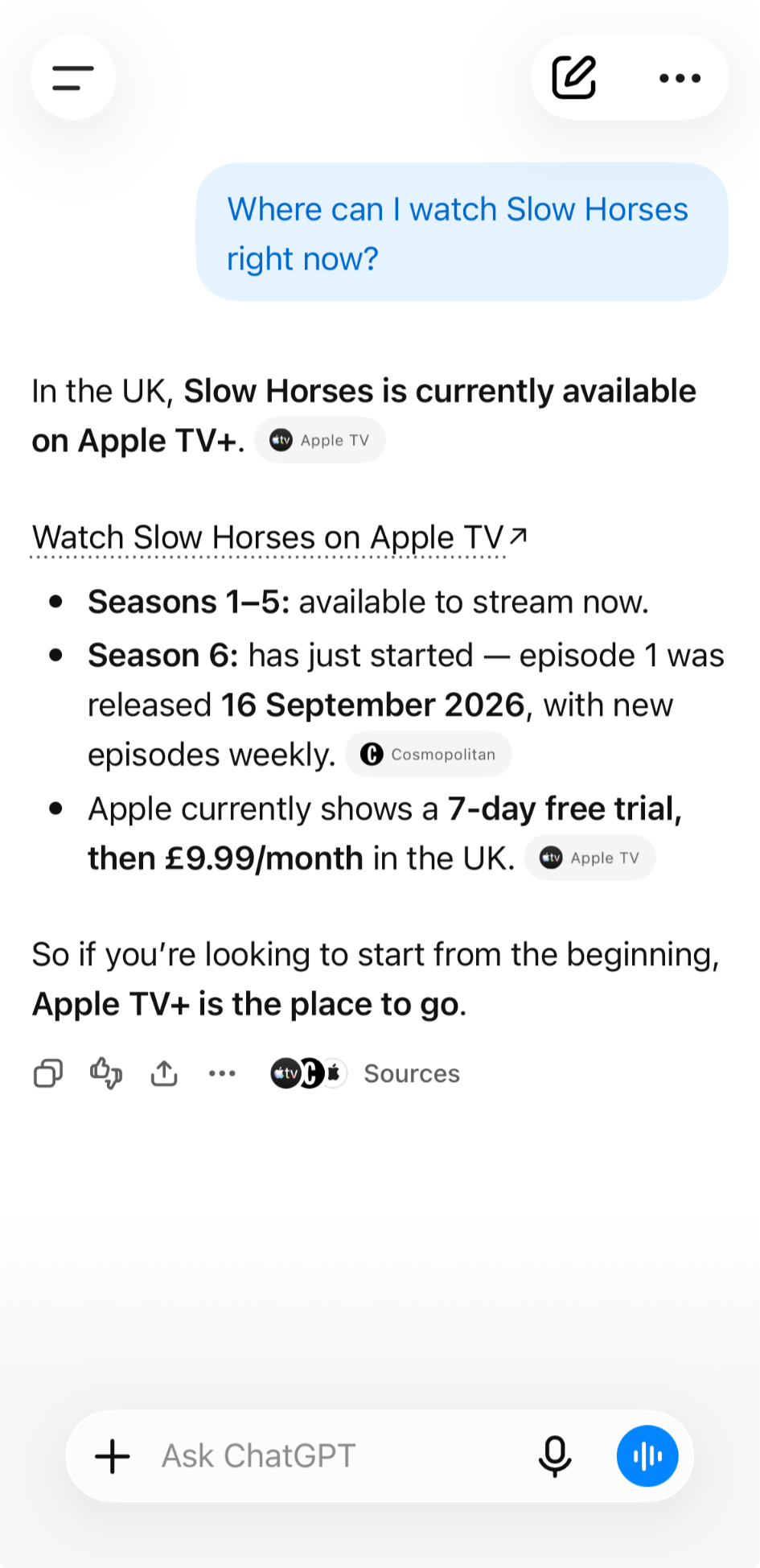
Advertising. Once video is a native surface in AI assistants, advertising can follow. As an experiment, you can ask any of the major assistants where you can watch a TV show and see the results. In our own informal testing, the top answers often don’t include a direct link to watch the show, or even a link to a trailer. This is a clear opportunity to improve recommendations for viewers and an opportunity to reduce the number of taps between finding something to watch and playing the video. Advertising can be coupled with this because an ad-supported stream, or trailer, could play directly in the conversation. For media companies this would enable advertising in a location which is currently not monetized.
Retention, for the AI assistants. Users are already asking AI assistants what to watch and then leaving to watch it somewhere else. Native video playback would keep the user in the conversation, adding interactivity to the chat and it would open up a route into the living room where AI assistants have no presence today. This would also deepen the context that AI assistants hold because they could know what a user watched rather than just what they asked about, ultimately making every future recommendation better.
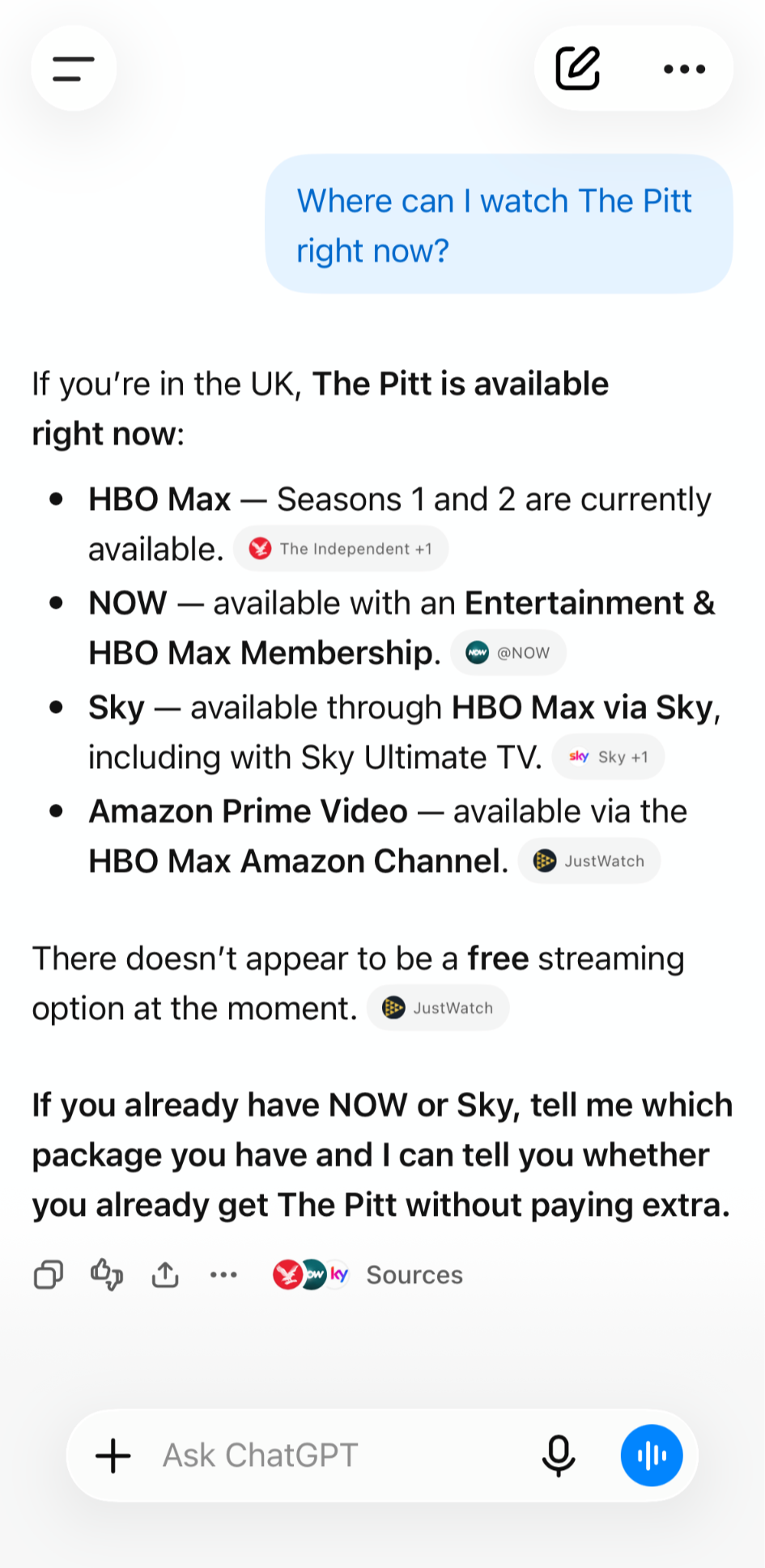
With many shows, it’s not obvious where users should click to start watching results
Some shows have direct links for where you can watch but this isn’t the case for many
Viewers gain too. Gracenote’s 2025 State of Play report found that people now spend an average of 14 minutes searching for something to watch, and nearly one in five give up on the session when they cannot find it. Asked what would help, two thirds pointed to the same thing: a single guide that works across all of their services and tells them where a program is available. An assistant that knows your taste and knows what you pay for could be the perfect fit.
For the makers of AI assistants there’s also a business case because their users are already asking what to watch. The problem is that they then leave to go and watch it somewhere else. Native playback would keep consumers in the app, giving them a route into the living room where they have no presence today.
What it takes to get there
MCP Apps is an extension to the Model Context Protocol that lets an MCP server ship an interactive interface alongside its tools rather than only returning text. This is the technology which can enable our vision for video streaming into AI assistants. Here the server declares its UI as a resource then the host renders it in a sandboxed frame inside the conversation. The two sides communicate over a defined channel. For a publisher that means your own app with your own branding, controls and video player, running inside ChatGPT, Claude or any other MCP-compatible AI assistant.
After building an MCP App, publishers will hit a hurdle when they try to play video. This is because there are feature gaps in support for video playback through MCP Apps. These include:
- Support for fullscreen playback
- Casting from a phone to a television
- DRM, which is arguably the biggest challenge
- Ad playback, measurement & beaconing
- Subscription management, entitlement checks and payment
Unfortunately none of these are niche requirements because they’re basic expectations for most streaming services today. When comparing to web browsers and native apps, all of these features are fully supported today. Adding support for the above is a pre-requisite for most publishers who want to stream video into AI assistants.
Additionally, while streaming services publish title pages for search engines, none of the major platforms offer a structured, authoritative feed of what they carry and where. This means that an AI assistant can’t easily see what a service offers and therefore can’t recommend it. A sensible first step for the industry is to publish catalog metadata openly, at title level, while keeping the streams themselves protected & encrypted. Being discoverable would cost very little.
What we’ve built
We hope you’re excited by the vision that we’ve set out here. To help the media & MCP communities to build towards this vision we’ve created a demo called Bitflix: a video streaming service running as an MCP App, with real video playback inside the AI assistant. This started as a way for us to figure out whether any of this actually works, and it turned into the fastest way we’ve found to show people what the future looks like. It works in Claude, ChatGPT or any AI tool which supports MCP Apps. When we demo this on a phone, that’s usually the moment the penny drops for whoever we’re showing it to.
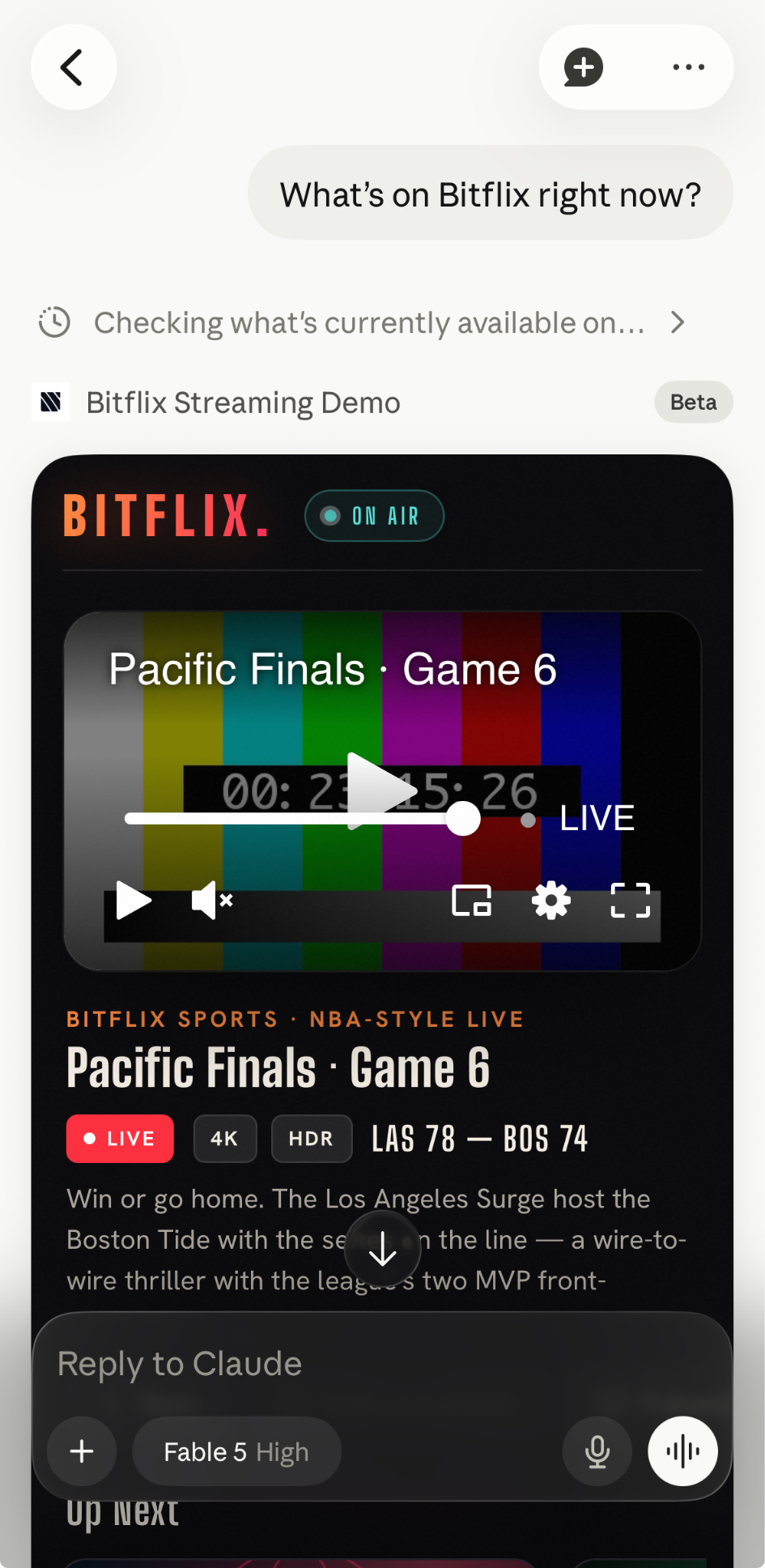
Bitflix video streaming demonstration app, shown here in Claude
We showed Bitflix at IBC and AGNTCon. Roughly 75% of people had an immediate “wow” moment and bought into the vision straight away. The rest either didn’t see the significance or didn’t think it mattered, which we found more surprising than the enthusiasm. Nobody else at IBC was showing anything like this.
Building Bitflix taught us where the gaps are to fully enable video streaming through MCP Apps. DRM is the first gap and we’re not the only ones to run into it. Developers in the MCP Apps community have run into exactly the same thing independently. This told us that this is a gap in the standard rather than a gap in our implementation. We’ve filed issues with the MCP Apps maintainers and started the conversations with the people who own the spec.
Bitflix is now an open source project and we’re welcoming contributions from the video streaming and MCP communities. You can find the Bitflix project here: https://github.com/bitmovin/bitflix-mcp-apps-example
We are working with the MCP community on the features above, with the aim of getting to a working group and a full proposal for Video over MCP.
What’s next
If you’re a streaming service, broadcaster or publisher who’s thinking about how your video shows up inside AI assistants. Or you’re working on MCP and want the video use case to be represented properly, come and talk to us. Clone the repo, file an issue, or get in touch.