


TL;DR
- Live streaming’s core trade-off is broken. Scale vs. sub-second latency has always been a painful compromise. Media over QUIC (MoQ) is the emerging IETF standard designed to solve it.
- MoQ replaces the inefficient “pull” model of HLS/DASH with a publish/subscribe fan-out architecture built on QUIC/HTTP/3, enabling sub-second latency for millions of concurrent viewers over standard web infrastructure.
- Bitmovin integrated MoQ playback into Player Web X as an isolated plugin, proving Player Web X’s extensibility for emerging protocols.
- Cloudflare built the relay layer, deploying open-source MoQ relays (moq-rs) across 330+ cities that automatically scale fan-out from one viewer to millions, with no proprietary lock-in.
Table of Contents
Live streaming has operated under an uncomfortable trade-off for years. Either achieve large scale distribution, or have sub-second latency, or have both but not without eye-watering infrastructure management and costs. However, this is where Media over QUIC (MoQ) comes in, introducing the latest approach to addressing this trade-off, with Bitmovin and Cloudflare demonstrating what that future looks like in practice.
In this blog, we’ll cover what Media over QUIC (MoQ) is, what Bitmovin and Cloudflare are building, and why it matters for the future of live streaming. Let’s get into it.
What is Media over QUIC?
MoQ is an emerging IETF standard that rethinks how live media is delivered over the internet. Built on QUIC and HTTP/3, it introduces a publish/subscribe distribution model that replaces the traditional “pull” approach of HLS and DASH, where millions of viewers each request the same segments independently, with a far more efficient fan-out architecture. The result is sub-second latency at broadcast scale, running over standard web infrastructure without specialized servers or complex peer-to-peer topologies.
MoQ isn’t a niche experiment. Engineers from Cloudflare, Meta, Google, Cisco, and others are actively shaping the standard through the IETF MoQ Working Group. The direction of travel is clear, and the question for streaming platforms is when, not if.

Real-time latency metrics demo during MoQ playback with Bitmovin’s Player Web X and Cloudflare
What Bitmovin is Building, and Why It Matters
Bitmovin’s work with MoQ starts with Player Web X, our next-generation web player built using structured concurrency and open plugin framework. The architecture of PWX has meant adding MoQ playback support didn’t require any changes to the player’s core codebase, showcasing the kind of extensibility PWX was designed to achieve, letting us move quickly on emerging technologies in isolated plugins.
But MoQ provides more strategic benefits to Bitmovin’s customers than the extensibility:
“MoQ is the architectural reset the industry has been waiting for. It is the first protocol designed from the ground up to deliver sub-second latency while simultaneously reducing the massive infrastructure strain associated with mega-event broadcasting, all while maintaining or even improving visual quality.
At Bitmovin, we’re not treating this as a future bet. We’re building for it now, because the platforms that move early will be the ones defining the next generation of live experiences, from sports and betting to live commerce and interactive entertainment.”
– Stefan Lederer, CEO & Founder at Bitmovin
The near-term opportunity is real where MoQ’s efficiency gains offer genuine capacity relief, in that when live audiences grow, traditional CDN architectures approach their limits during peak concurrent events. That is on top of the revenue to be gained in real-time interactive experiences like polls, betting and ecommerce. Those come in the 12-24 month window, once operators are comfortable with the infrastructure fundamentals.
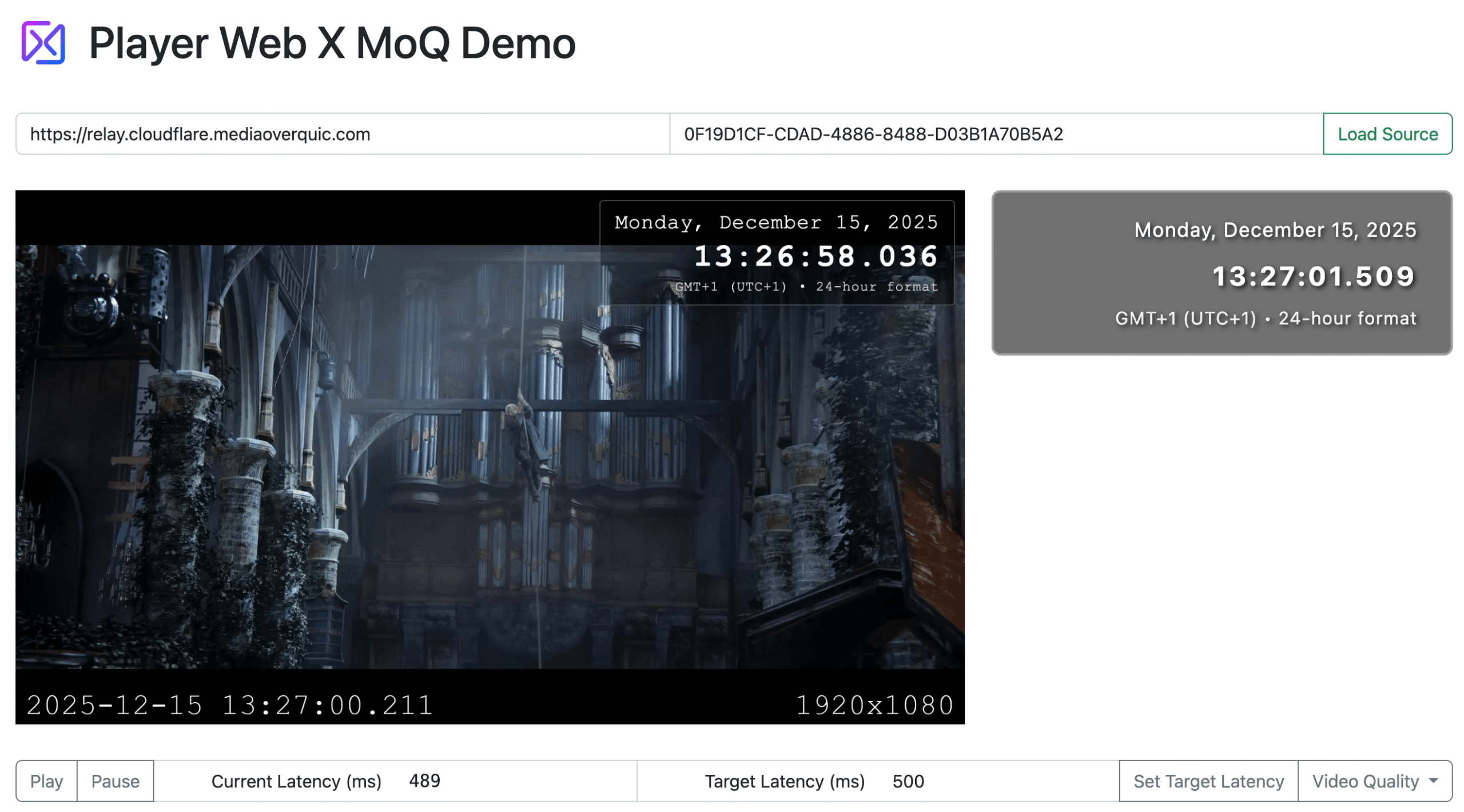
Bitmovin and Cloudflare MoQ demo showing sub-second latency
What Cloudflare is Building, and Why It Matters
Cloudflare’s contribution to MoQ is the relay network that sits between the encoder and the player. Rather than requiring broadcasters to build and manage specialized media delivery infrastructure, Cloudflare has deployed MoQ relays across its global network in more than 330 cities, turning its existing edge into a purpose-built distribution layer for sub-second live streaming. When a stream is published to the nearest relay, the network handles fan-out to viewers worldwide automatically, scaling from one viewer to millions without any additional configuration. Cloudflare is building this as open infrastructure for an open standard, with interoperability as a first principle. Their relays already work with publishers, players, and tools from across the MoQ ecosystem, including implementations from Meta, Meetecho, and the community-driven moq.dev project.
Cloudflare’s MoQ relay implementation, moq-rs, is fully open source. This isn’t a side project or a reference implementation that diverges from production: it’s the same code that runs on Cloudflare’s network. Keeping the implementation open is a deliberate, permanent commitment: MoQ is an open Internet standard, and Cloudflare believes the infrastructure that powers it should be open too. By developing in the open and contributing directly to the IETF standardization process, Cloudflare is helping ensure that MoQ matures as a shared foundation for the industry rather than a collection of proprietary, incompatible implementations.
“The streaming industry has spent too long locked into proprietary stacks that don’t talk to each other. MoQ changes that. Our implementation is open source, our relay network is built on an open standard, and we’re working alongside the rest of the IETF community to make sure it stays that way. The best infrastructure disappears into the background and that only happens when everyone can build on it.”
– Dane Knecht, CTO at Cloudflare

Cloudflare MoQ relay network distributing live streams at scale globally
Why This Partnership Works, and What It Signals for the Industry
The Bitmovin and Cloudflare collaboration is an interoperability story, and that’s precisely the point. MoQ’s value is only realised when the full stack, relay infrastructure, CDN, and player, works together seamlessly. Our NAB demo brings that to life: a live Cloudflare MoQ stream, distributed over their global relay network, playing back in real time through Bitmovin’s Player Web X.
No proprietary handshakes. No custom integration work. Just an open standard, working end-to-end.
That interoperability is what the industry needs to build confidence in MoQ as a production-ready direction. Fragmented implementations and vendor lock-in have historically slowed protocol adoption in streaming. The ecosystem approach, demonstrated by Cloudflare and Bitmovin building independently toward a common standard, is how MoQ avoids that fate.
There are real challenges still to solve. Server-side ad insertion, DRM at parity with incumbent solutions, and the vast installed base of legacy devices that can’t support QUIC will all require sustained industry effort. Neither Bitmovin nor Cloudflare is presenting MoQ as a wholesale replacement for HLS and DASH tomorrow. But the foundation is being laid, and the demo at NAB is evidence that it works today, on modern devices, at real-world scale.
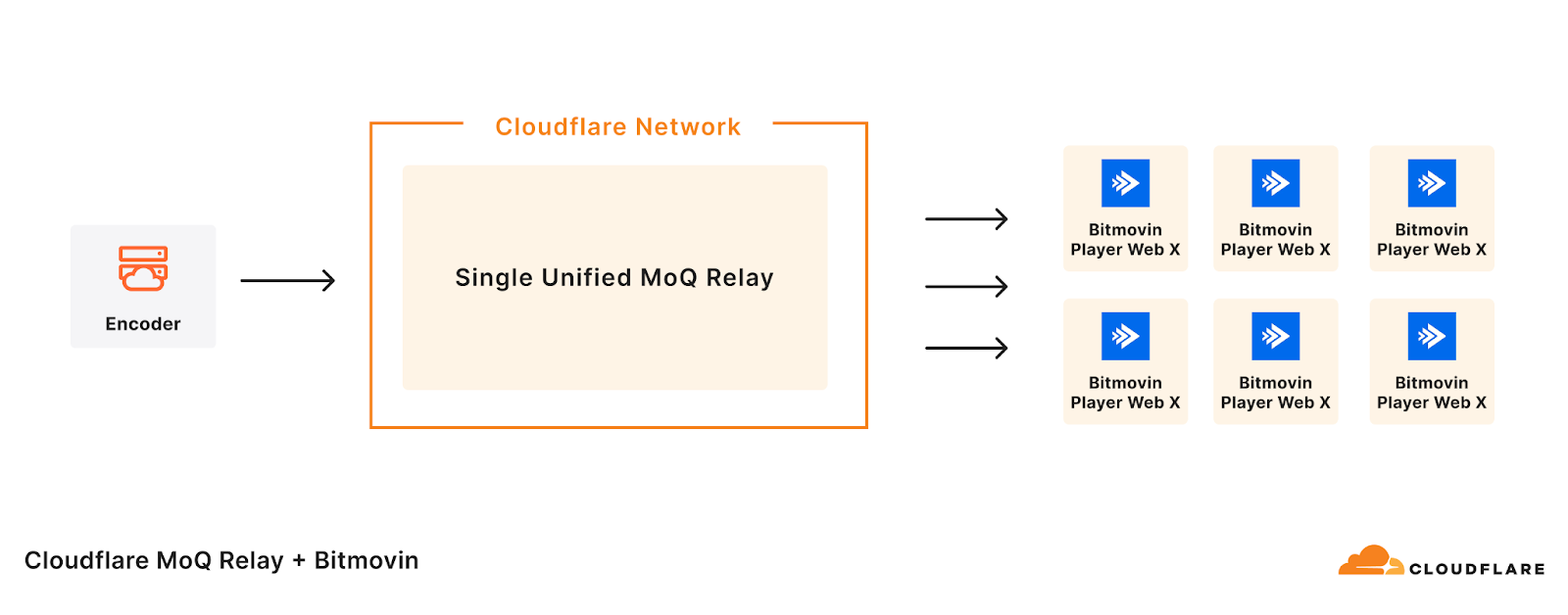
Diagram of Cloudflare MoQ relay network and Bitmovin’s Player Web X
See It Live at NAB 2026
Bitmovin and Cloudflare will be demoing MoQ playback live at NAB Show 2026. Come see the stream running in Player Web X and talk to our teams about what sub-second latency means for your platform.
Find Bitmovin at Booth W3323 | Find Cloudflare at Booth W2300G
Interested in exploring MoQ for your platform before then? Get in touch with the Bitmovin team.
FAQs
What is Media over QUIC (MoQ)?
MoQ is an emerging IETF standard that redefines how live media is delivered over the internet. Built on QUIC and HTTP/3, it uses a publish/subscribe model to fan out streams to millions of viewers simultaneously, replacing the traditional “pull” approach used by HLS and DASH. The result is sub-second latency at broadcast scale, over standard web infrastructure, without specialized servers or peer-to-peer complexity.
How is MoQ different from HLS and DASH?
With HLS and DASH, every viewer independently requests the same video segments from the CDN, which creates massive duplicated load at scale. MoQ flips this model: a stream is published once to a relay, and the network fans it out to all viewers automatically. This is dramatically more efficient, especially during high-concurrency live events like sports finals or product launches.
What is Bitmovin building with MoQ?
Bitmovin has added MoQ playback support to Player Web X, its next-generation web player. Because Player Web X is built with an open plugin framework and structured concurrency architecture, MoQ support was added as an isolated plugin, with zero changes to the player core. This means Bitmovin can move fast on emerging protocols like MoQ without destabilizing existing production deployments.
What use cases benefit most from MoQ?
Any live streaming scenario where latency directly affects viewer engagement or monetization stands to benefit: live sports, live commerce and shoppable video, interactive entertainment, real-time polls and audience participation, and any event where synchronization between the broadcast and second-screen experiences matters. MoQ also offers capacity relief during peak concurrent events, where traditional CDN architectures approach their limits.