
TL;DR
- Unlike general entertainment, sports require extremely low latency, high frame rates, and optimized bit rate to capture fast action and synchronous viewing experiences
- Advanced codecs and efficient encoding workflows can help deliver high resolution with minimal delay, crucial for bets and watch parties
- DRM alone isn’t enough; forensic watermarking embeds identifiers into streams to trace and curb content theft and account sharing
- Flexible monetization strategies expand revenue. SVOD, TVOD, AVOD, or combinations thereof enable providers to tailor business models to content and audience behavior
Table of Contents
There was a time when all you needed to build the best streaming experience was to create quality content and have a fast internet connection. However, with the explosion of over-the-top (OTT) platforms, the available options and viewers’ preferences have changed. This has caused an unprecedented segmentation of the OTT industry, as the needs of entertainment, news, and sports streaming are not the same.
To that end, this article will explore what’s needed to build the best streaming experience for sports and esports viewers.
What Makes the eSports and Sports Streaming Experience Different?
Both on-demand and live OTT media streaming have quickly become an important source of revenue for the sports industry, causing investment in the sector to skyrocket. But what makes sports streaming different from that of other industries? The answer lies in the unique needs of the sports industry and in viewers’ expectations.
- Publishing velocity – In certain industries, for example, Sport or News, every second matters. From having that goal, try or wicket that happens on the field, to having a specific clip published on the website – you must be first. To that end the Bitmovin encoder provides industry-leading speed and scale; whether the clip comes in from the live stream, or comes in from the edit bay Bitmovin’s split-and-stitch encoding approach gets it to your audience quicker.
- Syndication support – rarely is one sports asset used under one masthead, preparing a clip for syndication may be as simple as changing the bug/logo/watermark or maybe involve different workflow treatments. With Bitmovin encoding, the jobs can be tailored to the individual demands of your syndicators, broadcasters, or sponsors
- Image quality, latency, and bit rate – Depending on the industry, the standards of what is acceptable and what is not can vary drastically. For a newscast, picture quality, sound, and transmission delay may not be as important. For a concert, audio quality is paramount. For sports, an excellent frame rate and extremely low latency are essential.
- Digital rights management (DRM) and forensic watermarking The complex regional deals and negotiations behind high-profile sporting events are among the many reasons that the sports industry enforces the world’s strictest anti-piracy controls.
- Customization – Few viewers are as demanding as online sports fans about personalizing their experience. They expect multiple options on camera angles, commentators, statistics, and other information.
- Monetization models – The sports industry is one of the most flexible of all. It can use pay-per-view models for high-impact events, such as a World Cup final, as well as on-demand subscriptions for other content.

High Quality vs Low Latency
In streaming for the sports industry, which is more important: low latency or image quality?
According to a survey conducted by Ring Digital, in 2021, the majority of viewers don’t seem to mind that the average delay of live streaming is twenty to fifty seconds. Of those surveyed, 26.3 percent were aware of the delay but did not care, 24.4 percent were vaguely aware of the delay, and 22.6 percent had not noticed it. Only 26.8 percent responded that the delay was annoying.
Meanwhile, the consulting firm Deloitte states that “the single most important factor for fans is picture quality.”
Does this mean that latency in sports broadcasting is not important? On the contrary, latency is critical, even if viewers don’t perceive it as such. Two fundamental factors drive sports content providers to invest heavily in improving quality through low-latency streaming. The first is the rapid expansion of sports betting, and the second, more related to the COVID-19 pandemic, is the growing popularity of watch parties.
Online sports betting is not only a multimillion-dollar business in the U.S. states where it is already legal, but it can be a profitable source of revenue for OTT operators. Through strategic partnerships, live sports and esports providers could benefit from the legalization of betting in many states and even consider scaling back other monetization strategies, such as advertising. The problem? For this type of partnership to be fruitful, latency must be extremely low. In the world of gambling, a forty-second delay compared to other conventional transmission media is simply unacceptable.
In the case of watch parties, the stakes could be even higher, as the user experience is so important. Imagine a group of friends and family that decided to watch the live broadcast of a baseball game together from separate homes. Not everyone is using the same provider, and some may be watching the game on their tablet, while others are still using the traditional cable service. Who do you think is going to see the home run first? This uneven situation could ruin the whole eSports and Sports streaming experience.
And this doesn’t just apply to watch parties. A growing second-screen culture motivates many viewers to use their phone, tablet, or laptop while watching sports online to check statistics or complement their experience in other ways.
Low latency in live sports streaming is important today and will be even more important in the future. To build the best eSports and Sports streaming experience, OTT providers must address the root causes that affect latency, such as encoding technology, content delivery network (CDN), and video player buffering.
What about Streaming Bit Rate?
While image quality and latency are important for OTT sports, the bit rate cannot be neglected. In simple terms, the time it takes for the encoded video to be transmitted is directly linked to the bit rate. Since lower bit rates result in smaller files, they can be transmitted more quickly. In other words, lower bit rates favor lower latency. The problem is that higher frame rates require a higher bit rate. Consequently, for sports that involve fast movements, a high bit rate is critical to catch all the details.
The solution? Using platforms that provide the highest quality at the lowest possible bit rate. In this way, image quality can be preserved without affecting latency. To achieve this high-speed encoding, it is essential to use the most advanced codecs, such as AV1, VP9, H.264, and HEVC.
An additional advantage of modern codecs is that they are more resilient against errors that can degrade transmission quality. A low error rate is another factor that, if not handled properly, can affect the user experience. This is possible thanks to the advanced compression algorithms of these codecs, which minimize the impact of channel errors.
Anti-Piracy, DRM, and Forensic Watermarking
Delivering high-quality content with low latency is a challenge, not only from a technical point of view but also from an investment requirement point of view. For this reason, it is essential to safeguard this investment by implementing appropriate anti-piracy mechanisms.
According to a Parks Associates estimate, piracy and account sharing cost OTT operators more than $9 billion in revenue in 2019. Using DRM technology to control streaming access is not enough to solve the issue. DRM ensures that only authorized users have access to premium content; however, it does not prevent anyone from stealing your content by using, for example, a simple screen recording utility. This is why forensic watermarking is essential as an additional layer of security.
Forensic watermarking allows a unique identifier to be embedded in each session of OTT sports content so that you know with certainty which device is violating the transmission rights. This makes it easy to take immediate action, such as shutting off the service for that subscriber to prevent the retransmission of content.
Native Multidevice Support
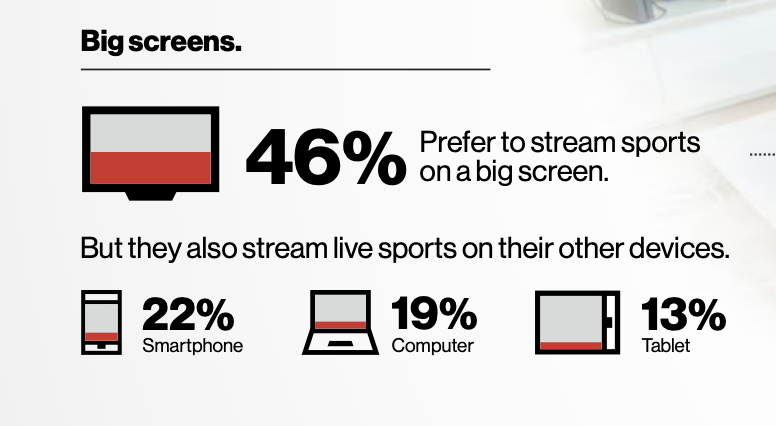
According to Verizon Media, 46 percent of viewers prefer to stream sports on a big screen, while 22 percent find it more convenient to do so from their phone, 19 percent from their PC, and 13 percent from a tablet. The study also shows that OTT video services that fail to deliver a quality eSports and Sports streaming experience across platforms can lose up to 25 percent in revenue. Another study conducted by Akamai Technologies revealed that up to 76 percent of users would be willing to cancel their subscriptions if the streaming service did not offer the expected quality.
Put another way: in a world dominated by devices of all kinds, from wearables to desktop PCs, offering quality streaming that adapts to each platform is key to maintaining customer loyalty.
Monetization Models
One of the biggest advantages of OTT services for sports is the flexibility to implement different monetization strategies. Subscription video on demand (SVOD), transactional video on demand (TVOD), and advertising video on demand (AVOD) are some of the most widely used models in the industry.
None of these models is mutually exclusive. This means that OTT providers could, for example, combine the SVOD and TVOD models (as DirecTV has done for years) to monetize both on-demand and live content. Another option would be to use the AVOD model (similar to how YouTube operates) so that users can view sporting events on-demand for free.
The possibilities are endless.
Conclusion
The key to building the best eSports and Sports Streaming Experience is to deliver high-quality video on as many streaming devices as possible. To this end, aspects such as image quality, latency, and bit rate must be balanced without overlooking security and anti-piracy mechanisms.
Achieving this balance does not have to be an overwhelming task. Bitmovin provides an end-to-end solution that allows content creators to reliably deliver quality video with low latency to their viewers across all major platforms. Moreover, Bitmovin’s built-in analytics allow you to diagnose issues in real-time while providing insights so you can optimize the user experience and stand out from the competition. In fact, Bitmovin has applied these best practices with the National Rugby League of Australia, find out how at the following links:
- [Case Study] The National Rugby League finds a winning team in Dalet and Bitmovin
- [Blog Post] Quality of Experience Issues: Leveling the Content Creation Playing Field (ft. Dalet)
- [On-Demand Webinar] How Dalet & Bitmovin solutions can help you innovate your sports content OTT strategy
FAQs
How does bit rate affect latency and quality in live sports streaming?
Lower bit rates can reduce latency because smaller data packets travel faster, but insufficient bit rates struggle to faithfully represent fast motion. High bit rate plus efficient encoding strikes the best balance for clear, low-latency playback.
Which monetization approaches work best for sports and esports OTT?
There’s no one-size-fits-all model; SVOD works well for dedicated fans, TVOD can capture premium event revenue, and AVOD lowers barriers for casual viewers. Hybrid approaches let providers unlock multiple revenue streams simultaneously.
What is forensic watermarking in sports streaming?
Forensic watermarking is a content protection technique that embeds a unique, invisible identifier into each individual stream, enabling rights holders to trace illegal redistribution back to the source user or session and take corrective action.
Why can’t standard DRM alone protect premium sports content?
Standard DRM controls access but doesn’t prevent content from being recorded or redistributed illegally. Forensic watermarking embeds unique identifiers in each stream session, enabling operators to identify and remediate breaches in real time.
What technology is required to stream live sports at scale?
Streaming live sports at scale requires efficient video encoding, adaptive bitrate streaming, low-latency delivery protocols, robust CDN infrastructure, multi-device playback support, and advanced security measures such as DRM and watermarking.
How does adaptive bitrate streaming work for live sports?
Adaptive bitrate streaming dynamically adjusts video quality in real time based on the viewer’s network conditions and device capabilities, ensuring continuous playback with minimal buffering during high-demand live sports events.