TL;DR
- 6 of the 13 TVs that played AV1 (46%) also played it with Widevine or PlayReady. Playing AV1 and playing protected AV1 are two different tests.
- Every Samsung and LG TV we tested from 2021 onward played AV1, and so did Chrome and Firefox on Windows, macOS and Linux, and Edge on Windows.
- 2 of the 12 set-top boxes and game consoles played AV1, both RDK-based operator boxes.
- VP9 played on 28 of 41 devices against AV1’s 22 of 42, and it held up better with DRM. H.264 played on every device we could test it on.
- These are first results from 42 device models, mostly entry-level and mid-range TVs. Roku, Fire TV and Android TV are not in this round.
Table of Contents
Introduction
If you are planning an AV1 rollout, you have probably already run the bitrate numbers, and they look good. You may also have played an AV1 stream on a new TV and watched it work. But bitrate savings only count on the devices that can actually play the stream, and for most premium services, that means playing it with DRM. This post answers what happens after the benchmark: how many devices in a real living room play AV1, and how many still play it once DRM is turned on.
Below are the first results from our device lab: AV1, VP9, HEVC and H.264, with and without DRM, on 42 device models across smart TVs, set-top boxes, game consoles and desktop browsers. It is written for the person who has to decide which codecs go in the ladder, and it ends with our recommendations and the tests we would run before committing.
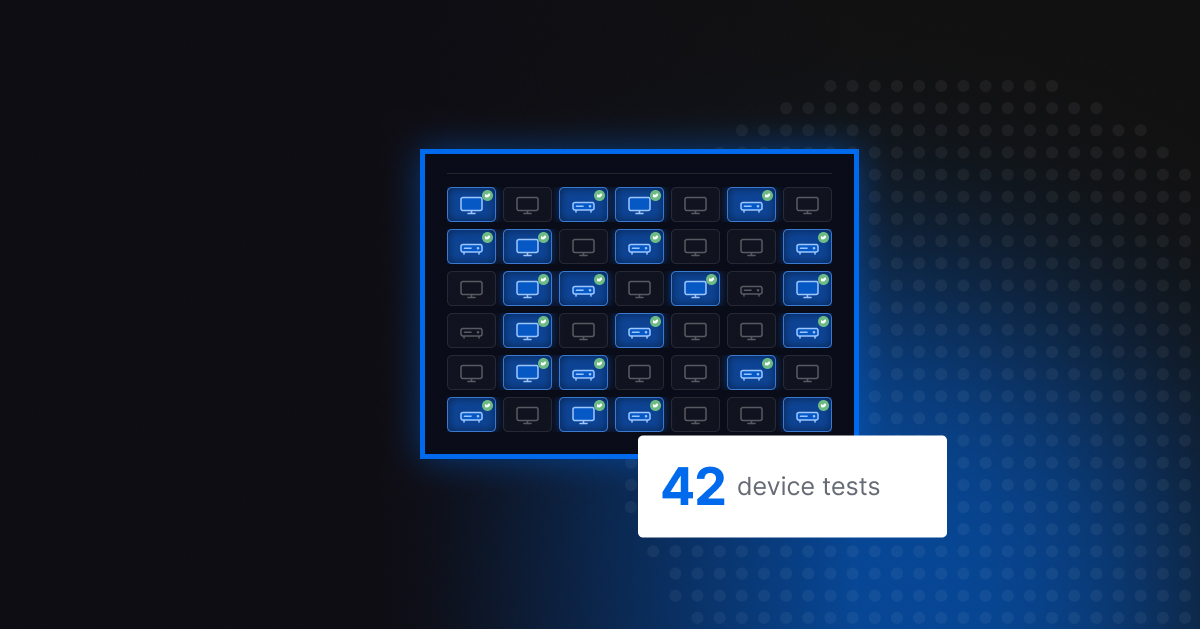
Testing codec compatibility across 42 device models
To evaluate device-level codec compatibility, we tested purpose-built streams in AV1, VP9, HEVC, and H.264 on 42 device models, with and without DRM, using web apps with the Bitmovin Player. We built the streams to test what each device can do, and the same streams played on other devices in each category, so differences in the results reflect device support rather than the streams. We counted a device as supporting a codec only if the stream started and played for at least 3 seconds. A capability flag or a spec sheet was not enough. We excluded runs that failed for reasons unrelated to the codec, such as a browser media policy or a network or delivery issue, so the number of devices tested differs by codec.
- Samsung and LG TVs from 2016 to 2025, plus two Vizio models. Samsung and LG together shipped about a quarter of the world’s TVs in early 2026, according to Counterpoint Research. In US homes, Samsung’s TV platform is the second most used after Roku, according to Parks Associates.
- Chromecast, Xbox and PlayStation devices, and several pay-TV operator set-top boxes.
- Chrome, Edge, Firefox and Safari on Windows, macOS and Linux.
Where the lab is thin: most of our TVs are entry-level and mid-range models, so newer high-end TVs may do better than these results show. This round tested web apps only. Most streaming services use native apps on consoles and streaming sticks, so those results may differ. Roku, Fire TV and Android TV are not included yet, and Dolby Vision is outside the scope of this round; for Dolby Vision on AV1, see our Dolby Vision Profile 10 blog. We tested only a few phones, so mobile is out of scope here.
AV1 compatibility varies across TVs, set-top boxes and consoles
AV1 played on 22 of the 42 device models: 13 of 22 TVs, 2 of 12 set-top boxes and consoles, and 7 of 8 desktop browsers. For a team evaluating AV1, the newer TVs are the encouraging part. Unprotected playback is also only half the test, as the DRM section below shows.
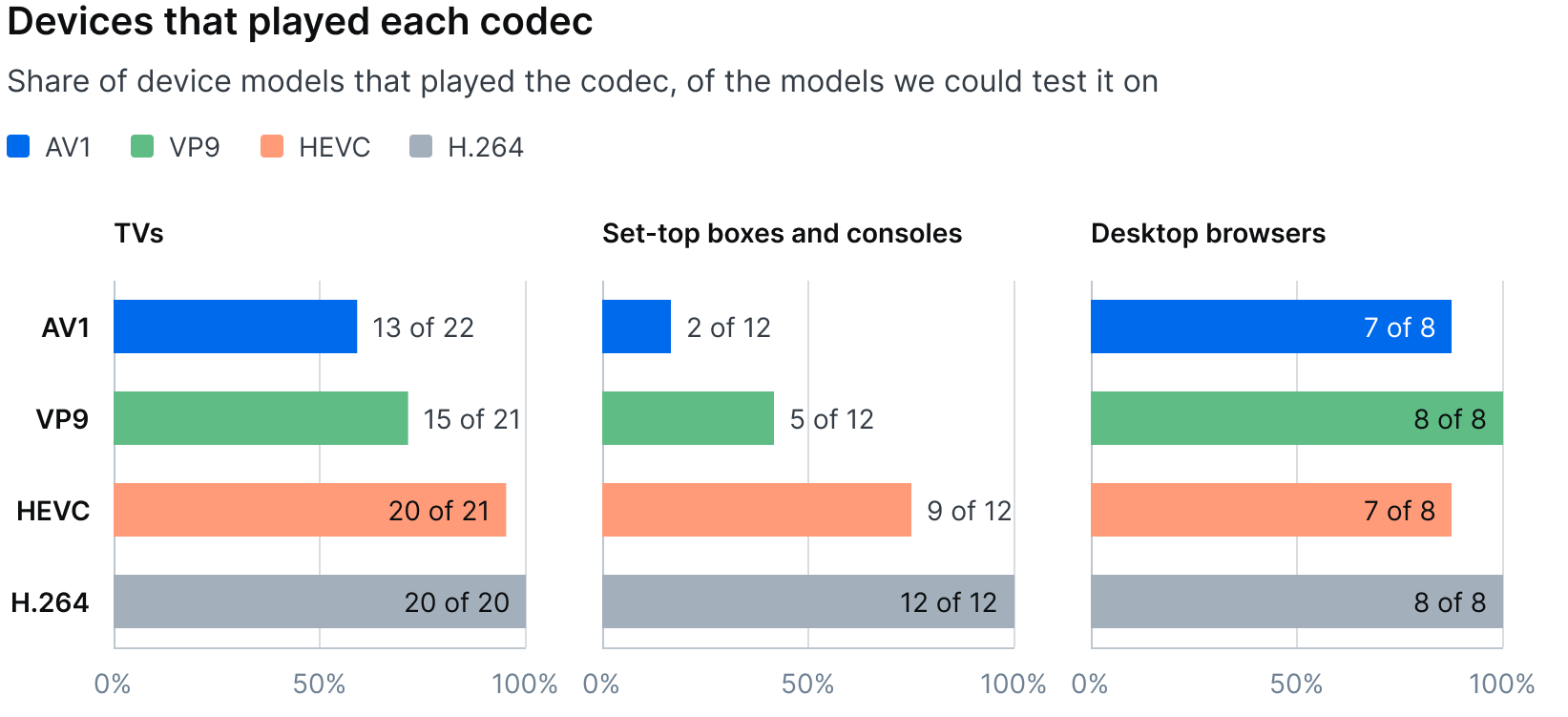
Bitmovin device lab, September 2026 · 42 device models · confirmed codec compatibility on tested devices, web playback · labels show devices that played the codec / devices we could test it on
On TVs, the model year decided the result. Every Samsung and LG TV we tested from 2021 onward played AV1, and so did our 2020 Samsung. None of the TVs from 2019 or earlier with a clear result played AV1. Vizio showed the same split: our 2022 Vizio played AV1, and our 2021 Vizio did not.
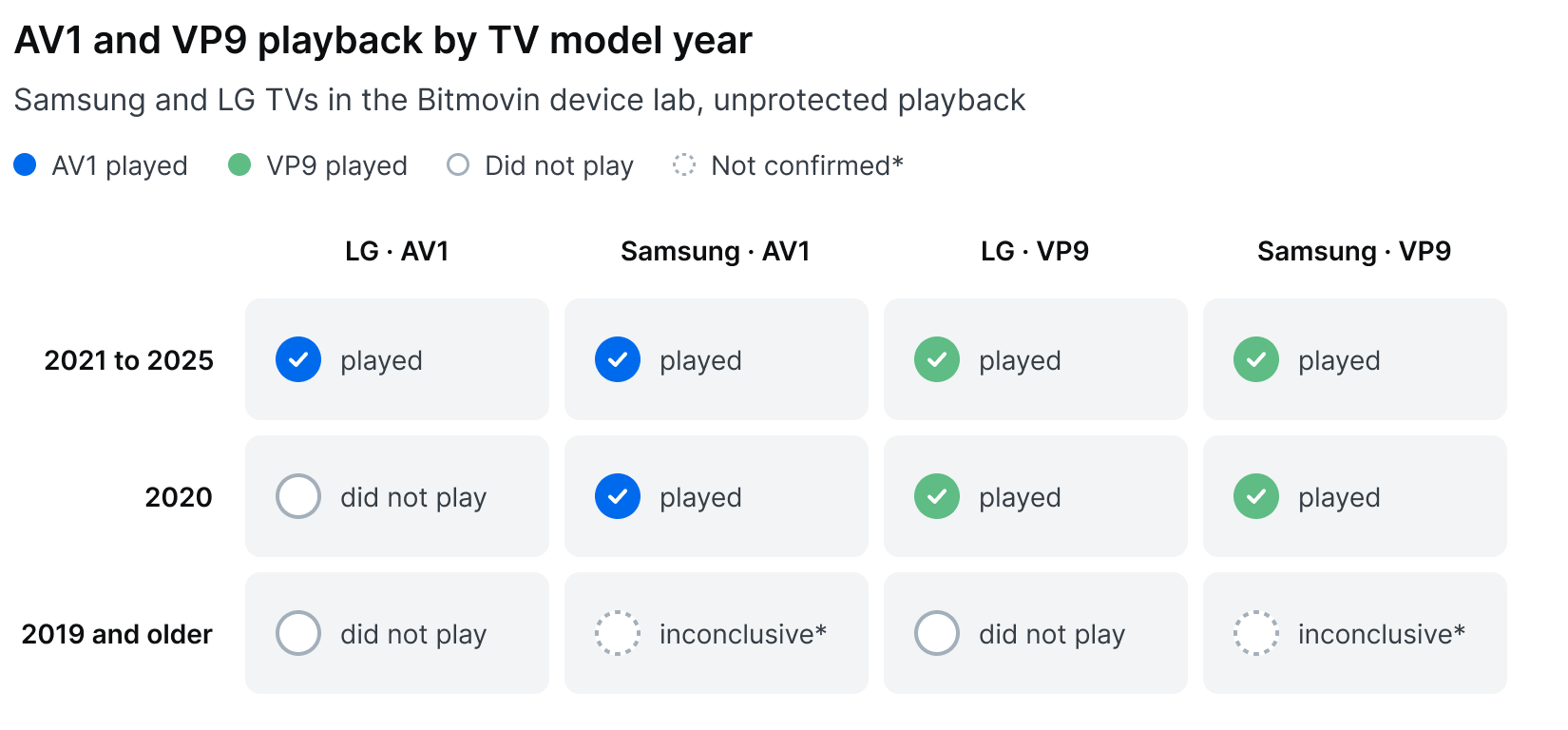
* No confirmed playback on older Samsung models. Results for the 2016 Samsung were inconclusive for AV1 and VP9, as were VP9 results for the 2019 Samsung.
Our three 2020 LG TVs are entry-level 4K sets (UN7100 series). They reported no AV1 support in web apps, although LG’s webOS TV 5.0 specification lists AV1 for Ultra HD models. Don’t rely on the spec sheet alone; test on the devices your viewers have.
AV1 support was far thinner among the set-top boxes and game consoles. Only 2 of the 12 we tested played it, an Amlogic X4 box and the Astro Ultra box, both built on RDK, a platform many pay-TV operators use. The Amlogic X4 was also the only box to play AV1 with DRM (Widevine), while the Astro Ultra played AV1 and AV1 HDR10 without protection but did not play it with Widevine. None of our Chromecasts (2nd gen, 3rd gen, Ultra) or Xboxes (One S, Series S) played AV1. Our PlayStation 4 and PlayStation 5 reported AV1 support, and playback started but stalled before we could confirm it.
Desktop browsers: AV1 played everywhere except Safari on older Macs
Chrome and Firefox played AV1 on Windows, macOS and Linux, and Edge played it on Windows. Safari did not, because our Safari tests ran on 2018 Intel Macs.
That is expected. Safari plays AV1 only on devices with an AV1 hardware decoder, according to WebKit. Apple first added one to Macs with its M3 chips. We have not yet tested Safari on an M3 or newer Mac.
AV1 playback support does not guarantee DRM compatibility
Of the 13 TVs that played AV1 in the clear, 6 (46%) also played it with Widevine or PlayReady. The other 7 reported no support for AV1 with DRM. A rollout planned from unprotected tests alone would reach far fewer TVs with AV1 than expected, so the codec test and the DRM test have to run together. Protected playback runs through the TV’s secure video path, which the platform has to enable for each codec separately. On some TVs, it is enabled for H.264 and HEVC but not for AV1.
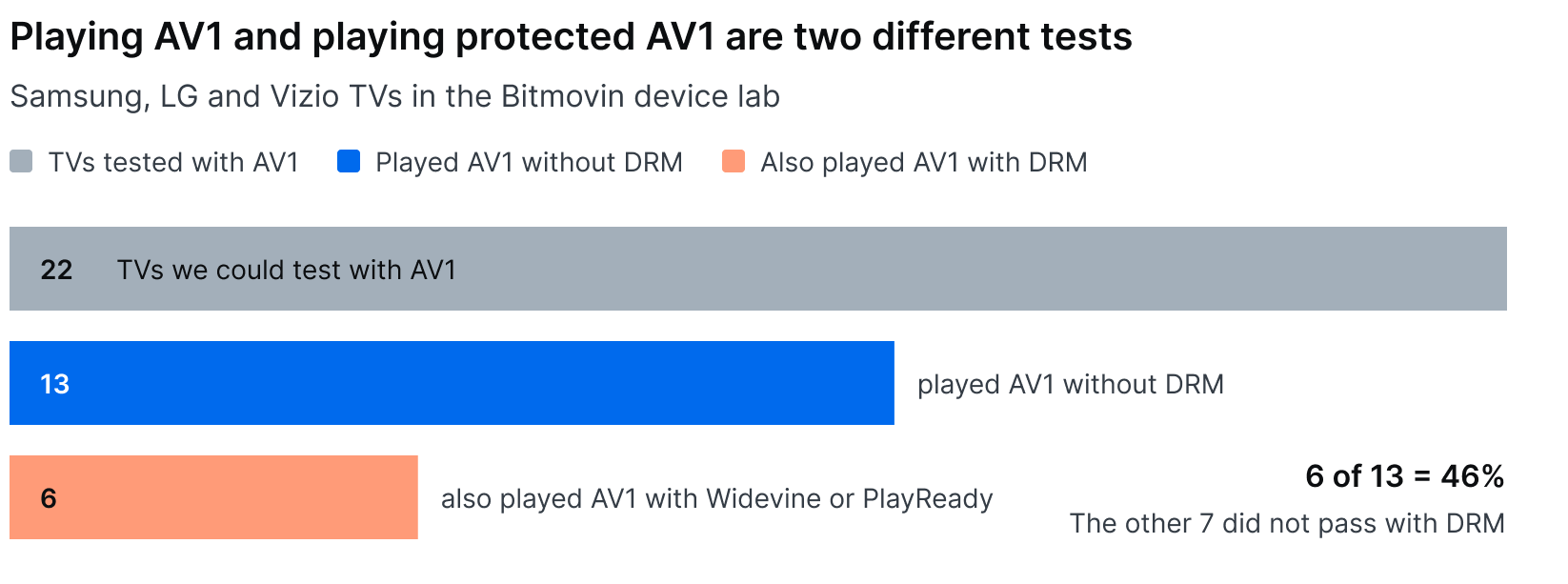
Bitmovin’s device lab, September 2026 · AV1 DRM compatibility on 22 tested TVs, web playback
On Samsung, every TV from 2022 onward played AV1 with DRM. On LG, the results were mixed: our two 2024 LGs are the same model, but only the one with newer software (webOS 10.3.1) played AV1 with DRM. Test on the firmware your viewers actually have, and test again after major updates.
| Brand | Model year | Played AV1 with DRM? |
| Samsung | 2022 to 2025 | Yes |
| Samsung | 2020, 2021 | No |
| LG | 2022 (entry-level) | Yes |
| LG | 2024 (newer software, webOS 10.3.1) | Yes |
| LG | 2024 (older software, same model) | No |
| LG | 2021, 2022 (high-end), 2023, 2025 | No |
| Vizio | 2022 | No |
AV1 with DRM on the 13 TVs that played AV1 without protection. Bitmovin device lab, September 2026. Widevine or PlayReady, tested in web apps.
Bitmovin’s VOD Encoder, part of Encoder Version 3, produces AV1 with Widevine, PlayReady and FairPlay protection, so the encoding side is ready when the devices are.
VP9 provides additional compatibility on older devices
VP9 played on every device that played AV1, plus six more. On TVs it added LG’s 2020 model and the 2021 Vizio. On set-top boxes it added the Chromecast Ultra, the Comcast Xi6 and the Astro Ulti. It also played in Safari on our Intel Macs, where AV1 did not.
Every desktop browser played VP9. On Safari we could test it only without DRM. Safari also reported support for VP9 in HDR, but we could not confirm playback.
VP9 was also more consistent with DRM than AV1. 14 of the 15 TVs that played VP9 also played it with DRM, against 6 of 13 for AV1, and the only exception was the 2020 Samsung. For a platform already shipping AV1, the question is whether those extra devices justify a third codec in the ladder.
HDR playback does not guarantee HDR output
Every TV that played VP9 also played it in HDR10 (15 TVs), and the same held for AV1 except one TV: the 2020 Samsung played AV1 but not in HDR10 (12 of 13 TVs). A TV playing an HDR stream only tells us it decoded the video. It does not tell us the screen showed HDR.
For TVs, we could only rely on the TV’s own report that it handles HDR. Of the 15 TVs that played HDR, 13 reported that they recognize it as HDR. That is a good sign, not proof of what viewers see on screen.
What vendor specifications show
Our results reflect web playback on the devices in our lab. Vendor specifications and market data add context on where support is heading.
The manufacturers’ own specifications tell the same story. Samsung’s developer specification for 2020 TVs is the first to list AV1 decoding, for every model group except the entry-level Full HD group; the 2019 specification does not mention AV1, and the 2021 specification lists it for every group. LG’s specifications for webOS TV 5.0 and 6.0, the 2020 and 2021 platforms, list AV1 for Ultra HD and 8K models only, and webOS TV 4.5 lists VP9 but not AV1.
The market has moved in the same direction. Netflix reported in December 2025 that 88% of the large-screen devices submitted for its certification between 2021 and 2025 support AV1, and that AV1 now carries about 30% of its streaming (Netflix Tech Blog, via Broadband TV News).
For set-top boxes, the specifications show where support is changing
The 2020 Chromecast with Google TV (4K) has no AV1 decoder; Google added one with the Chromecast with Google TV (HD) in 2022 and the Google TV Streamer in 2024, and the Android 14 compatibility definition requires AV1 decoding on new TV devices. Amazon’s developer specifications list AV1 on the Fire TV Stick 4K Max (2021), the Fire TV Cube (3rd generation, 2022), the Fire TV Stick 4K and 4K Max (2023) and every 4K stick since, but not on the Fire TV Stick (3rd generation), the Stick Lite or the 2024 Fire TV Stick HD.
Roku documents AV1 for DASH only and calls decoder support device-specific, without a per-model list. Apple’s fourth-generation Apple TV 4K, announced in October 2026 and shipping on 13 November, is the first Apple TV with a hardware AV1 decoder. New boxes ship with AV1. Most of the boxes already in homes predate it.
For desktop browsers
The dates matter less than they once did: Chrome has played AV1 since version 70 (2018), Firefox since 67 (2019) and Edge natively since 121 (January 2024), according to caniuse.com.
VP9’s reach is older than AV1’s on every platform we looked at. Samsung’s 2019 specification already lists VP9 for its premium, standard and first basic model groups, so the inconclusive VP9 result on our 2019 Samsung may reflect the web playback path rather than the decoder. Amazon lists VP9 on every Fire TV since the 2015 Fire TV (2nd generation), including models with no AV1 decoder, and in desktop browsers VP9 arrived with Chrome 25, Firefox 28, Edge 79 and Safari 16 (caniuse.com).
Key considerations for codec adoption
Codec efficiency and unprotected playback are not enough to decide a rollout, least of all with DRM in the chain. Based on these results, here’s what we’d recommend, and what we’d test before committing:
- Keep H.264 as the fallback. It was the only codec that played on every device we could test it on.
- Put AV1 at the top of the ladder for unprotected streams on Samsung and LG TVs from 2021 onward and on Chrome, Edge and Firefox on desktop, the devices where it played in every case we tested. For DRM-protected content, enable it only on devices where you have confirmed protected playback, such as Samsung TVs from 2022 onward.
- Decide VP9 from your own device mix. In our lab it added two TVs and three set-top boxes, and more TVs played it with DRM. Whether that is worth a third codec depends on how many of those devices your viewers own.
- Test AV1 with your DRM turned on, on the TVs you plan to serve, before you ship. 7 of the 13 TVs that played unprotected AV1 in our lab reported no support for AV1 with DRM.
- Test on real devices, and test again after major software updates. Two units of one LG model gave different DRM results on different software versions.
Treat these results as a starting point. Next, we plan to add more high-end TVs, and we want to test Roku, Fire TV and Android TV. Roku leads the US TV platform market, and Omdia reports that Android TV leads in Europe, so both matter for the full picture.
If you want to run the same test on your own streams, Stream Lab plays your HLS or DASH stream on real devices in our lab and reports which ones played it. Bring the stream you plan to ship, with DRM on.
Sources
- Best Video Codec: An Evaluation of AV1, AVC, HEVC and VP9
- Device fragmentation is changing how streaming services support more devices
- Counterpoint Research: Global TV Market Share, Quarterly, June 9, 2026
- Parks Associates: Roku and Samsung dominate connected TV platforms, April 22, 2026
- Omdia: VIDAA set to overtake LG’s webOS in Europe, April 15, 2026
- WebKit: WebKit Features in Safari 17.0
- Apple: Apple unveils M3, M3 Pro, and M3 Max, October 30, 2023
- Samsung Developers: 2019 TV Video Specifications, 2020 TV Video Specifications, 2021 TV Video Specifications and TV Model Groups, accessed November 3, 2026
- LG webOS TV Developer: AV Format on webOS TV 4.5, 5.0 and 6.0, accessed November 3, 2026
- Netflix Tech Blog: AV1, now powering 30% of Netflix streaming, December 2025, as reported by Broadband TV News, December 5, 2025
- Google: Android 14 Compatibility Definition, section 2.3.2 Television Media
- Amazon Developer: Fire TV streaming media player specifications and Fire TV Cube specifications, accessed November 3, 2026
- Roku Developers: Streaming specifications, accessed November 3, 2026
- 9to5Google: Chromecast vs Google TV Streamer, October 1, 2024; Gizmodo: Chromecast with Google TV (HD), September 22, 2022
- Broadband TV News: Apple unveils new Apple TV 4K with Siri AI and AV1 support, October 16, 2026
- caniuse.com: AV1 video format and WebM video format, accessed November 3, 2026
More from Encoder Version 3
- Encoder Version 3: The same picture with fewer bits
- AV1 benchmark: Bitmovin vs. AWS Elemental MediaConvert
- H.264 Per-Title Encoding benchmark
- Dolby Vision Profile 10 support for AV1 encoding
FAQs
How can developers verify AV1 and VP9 compatibility before deployment??
Test your actual HLS or DASH streams across the device models and software versions your audience uses. Validate both unprotected and DRM-protected playback where applicable, rather than relying solely on manufacturer specifications or reported codec capabilities. Real-device testing can help identify compatibility differences before enabling a codec for production traffic.
Does AV1 playWhy might a device support AV1 but not DRM-protected AV1 playback?back mean a TV can also play AV1 with DRM?
Codec decoding and DRM-protected playback involve different device capabilities. A device may decode an unprotected AV1 stream but lack the necessary support for AV1 within its protected playback path. Developers should validate AV1 with their intended DRM configuration, including Widevine or PlayReady where applicable, before enabling protected delivery.
When should streaming platforms consider VP9 alongside AV1?
VP9 can provide additional compatibility on devices where AV1 playback is unavailable or cannot be confirmed. Whether supporting both codecs makes sense depends on your audience’s device mix, DRM requirements, and the operational costs of maintaining additional encoded renditions. Evaluate the additional device coverage against those costs before adding VP9 to your encoding strategy.
How should developers handle devices that don’t support AV1 or VP9?
Maintain a compatible fallback, such as H.264, and ensure your playback application can select a supported codec for each device. Test the fallback behavior across your target platforms, including DRM-protected content where required. Codec selection should reflect the capabilities of the device and its playback environment.
Can firmware updates or native applications affect AV1 and VP9 compatibility?
Yes. Codec compatibility can vary by firmware version and application environment. In Bitmovin’s tests, two TVs of the same LG model produced different results for DRM-protected AV1 playback depending on their software versions. The research evaluated web applications, so developers using native applications should validate compatibility separately and repeat testing after major software updates.