
TL;DR
- At Demuxed London 2025, the focus was on smarter playback technologies that dynamically optimize QoE through improved adaptation logic, data awareness, and real-time decision-making.
- Enhancements in ABR decisioning, buffering strategies, and playback heuristics are enabling more resilient streaming across fluctuating network conditions and device environments.
- Data and observability are shaping the next generation of players. Rich client-side analytics and telemetry empower better performance tuning, faster troubleshooting, and more granular insight into viewer experience.
- Inclusive streaming experiences, including support for advanced accessibility features, are gaining strategic importance in player development.
Table of Contents
Demuxed London 2025 brought together the people who actually build video, not just talk about it. For two days in October, playback engineers, encoding specialists, player developers and streaming platform teams filled a room to trade scars, share ideas and compare notes on what really works in production. The event grew out of the SF Video Technology community, so the talks are unapologetically technical and every session is aimed at people who live in metrics, traces and code reviews. That makes Demuxed the ideal place for Bitmovin and the Christian Doppler Laboratory ATHENA to show how our joint research turns into tools that developers can actually use. In London we brought two stories to that audience, one about teaching the video player to learn for itself under real network conditions and one about using AI to make live streams more accessible with sign language avatars.
Why Demuxed was the right audience
Demuxed is very much an engineer first conference, which means the bar for “useful” is high. Attendees want to see real data, real trade offs, and enough detail that they could try an idea in their own players or pipelines next quarter. That is exactly why we chose this event to present our recent work on self learning adaptive streaming and sign language avatars, since both projects are ready for hands on experimentation rather than just blue sky concepts.
For Bitmovin and ATHENA, Demuxed is also where the right conversations happen in the hallway afterwards. Player engineers want to know how a model runs on their low power devices, SREs ask how the approach impacts error budgets and QoE, and product owners challenge us to explain where this fits into an existing roadmap. The talks were designed to start those conversations, not to be the last word.
Session 1: Teaching the player to learn for itself
Alodi Jutglà Serrat opened the first session by grounding the room in a simple reality, video already is the internet for a lot of users. Streaming takes the majority share of global traffic, viewers expect 4K or at least rock solid HD, and they have very little patience for buffering or sudden quality drops. At the same time, every extra bit has a cost in storage, delivery and device energy, so the old habit of “just add more bitrate” is becoming harder to justify.
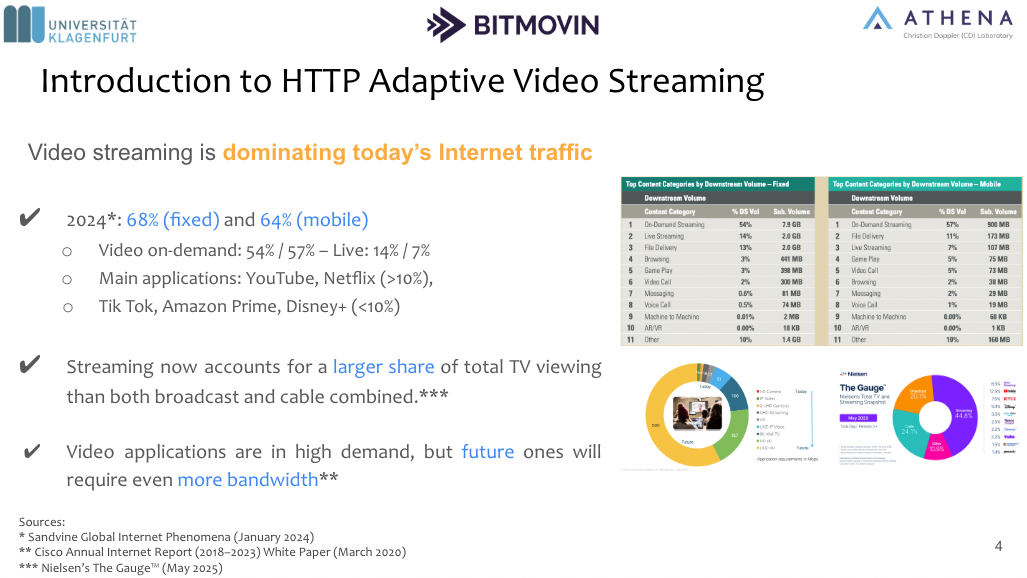
Slide from Hadi and Alodi’s presentation: Video streaming is dominating today’s Internet traffic
From there, the talk challenged one of the most familiar tools in adaptive streaming, the fixed bitrate ladder. Instead of treating the ladder as a static template, the research combines three ideas that make it responsive to real networks and human perception:
- Network aware ladders, shaped by measured bandwidth distributions and request probabilities so more rungs sit where clients actually operate.
- Quality aware ladders, which remove rungs that users cannot distinguish using Just Noticeable Difference (JND) thresholds and in some cases save around 30 percent bitrate without hurting perceived quality.
- Per title encoding, which adjusts resolution and encoding parameters to each asset instead of forcing every video into the same 1080p centric ladder.
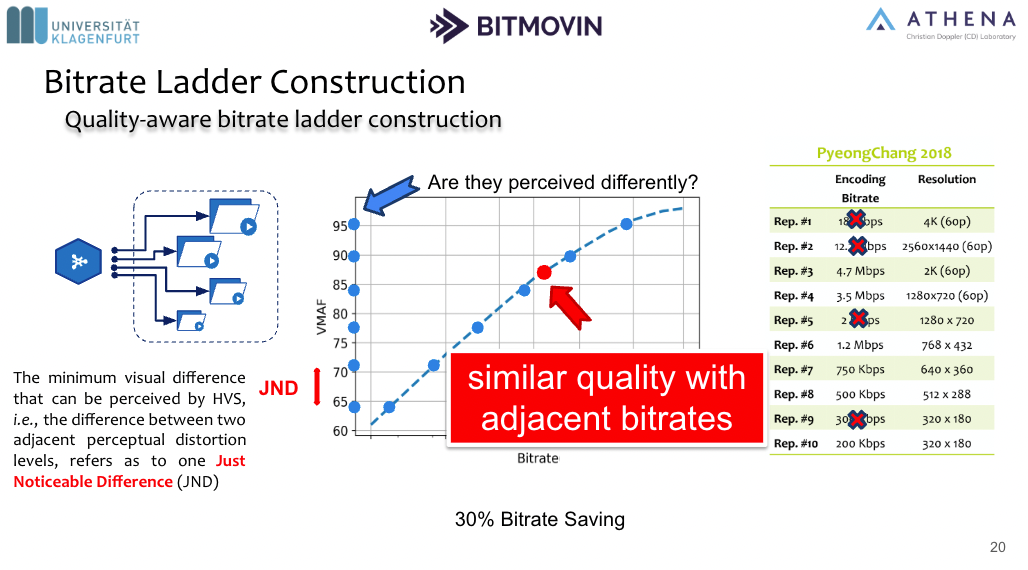
Slide from Hadi and Alodi’s presentation: Bitrate ladder construction” with the JND and 30% bitrate reduction example
For developers, this is attractive because it does not require a new streaming format or a rewrite of the player. It is a smarter way to design the same manifest structures most services already use, just informed by better data.
Using GPU devices without running a second ladder
The session then turned to a question that many Demuxed attendees wrestle with, how to take advantage of GPU capable devices without fragmenting the whole workflow. Running a separate ladder for GPU clients would double storage and complicate CDN caching, so the team explored a different pattern.
In the experiments, each representation is paired with a small, content specific neural network that acts as a post processing filter. The model is trained against the original source, then compressed from around 60 kilobytes to roughly 12 kilobytes using pruning and quantisation, which makes it realistic to send as metadata alongside segments. CPU only devices simply request only bitstream per usual and play the regular ladder, while GPU capable clients request and load the model and apply it in real time to clean up artifacts at the same bitrate.
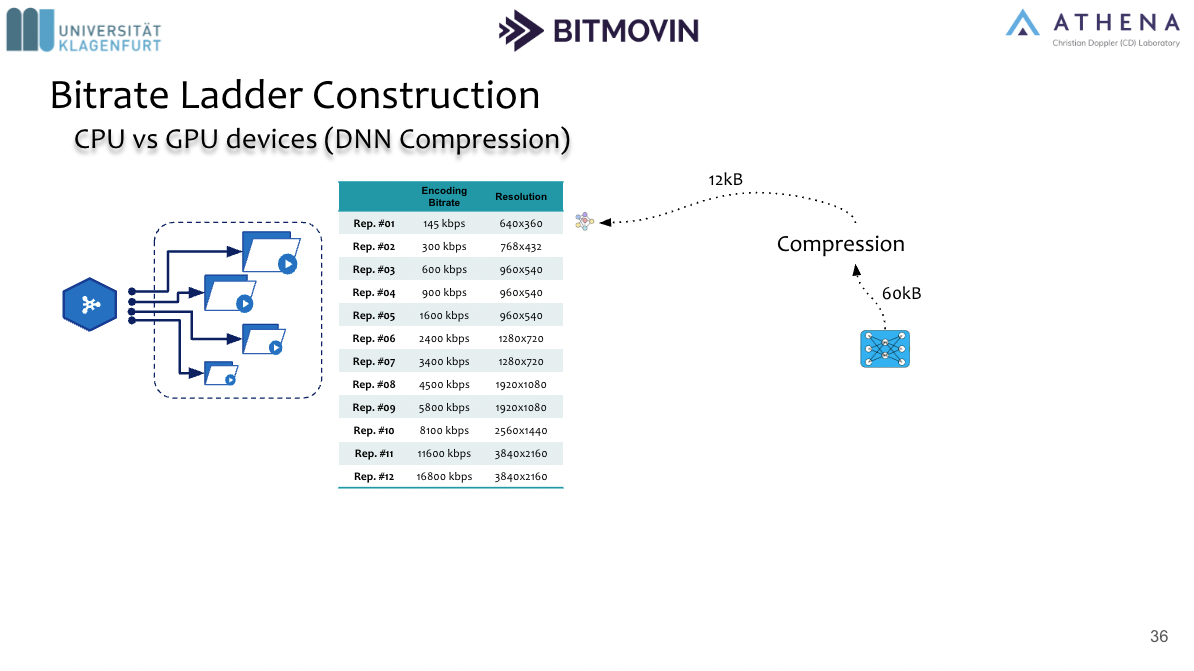
Slide from Hadi and Alodi’s presentation: CPU and GPU capable devices” with storage cost and model size comparison
This design lets teams offer a premium experience on more powerful devices without maintaining a separate set of renditions or changing their manifests. It is an incremental enhancement that can be A/B tested like any other playback feature.
A solution to reduce the training cost is presented as follows. Using all patches to train a separate network for each content can be expensive. Based on the spatial and temporal complexity of the patches, only the most informative ones are selected, leading to 84%–96% savings in training cost without compromising quality.
Letting the player self train when bandwidth drops
The final part of the talk moved the intelligence into the player itself and asked what would happen if bandwidth drops could become training data instead of just a painful glitch. When a session steps down from a high resolution segment to a lower one, the client has two versions of almost the same content at different qualities. That pair is perfect for training a tiny model locally.
The proposed method downscales the buffered high resolution segment to match the lower resolution, trains a shallow network on that pair, then applies it to upcoming low resolution frames. In the demo, training finished in around 0.1 seconds for a 2 second segment and delivered about 1 dB improvement over standard bicubic upscaling, which is visible as sharper edges and fewer artifacts while the network recovers.
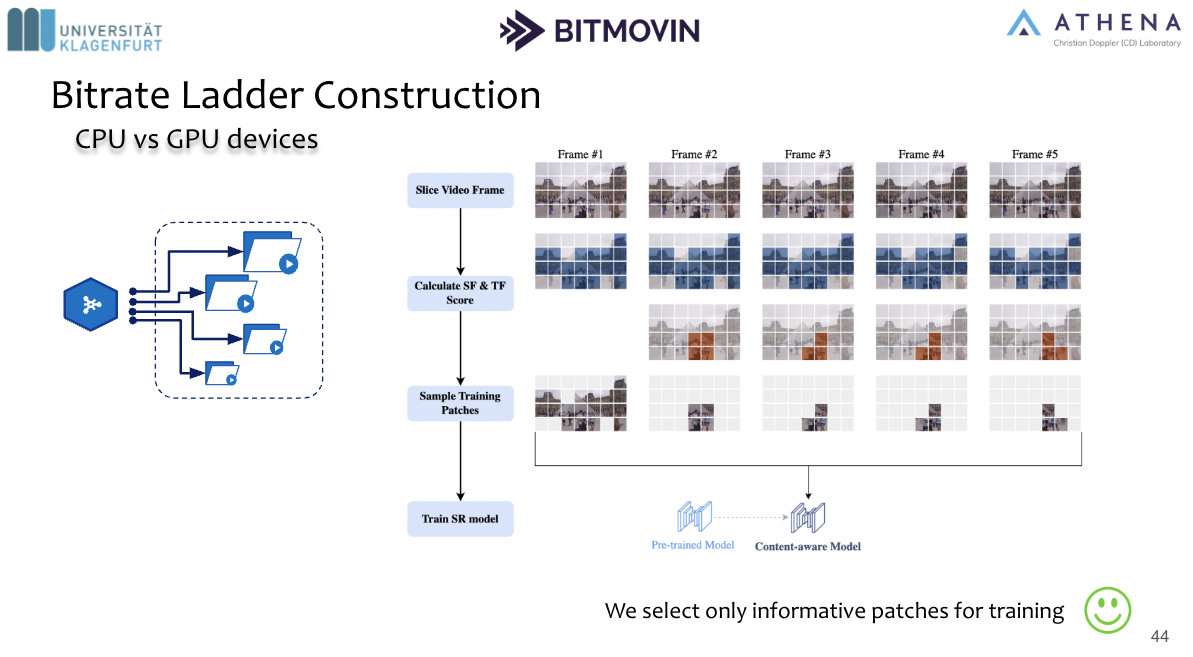
Slide from Hadi and Alodi’s presentation: Self training on the player side for quality enhancement
For developers, this is interesting because it requires no new server feature and no manifest changes. It is purely a client side experiment that can live behind a flag and be rolled out gradually by platform or device class.
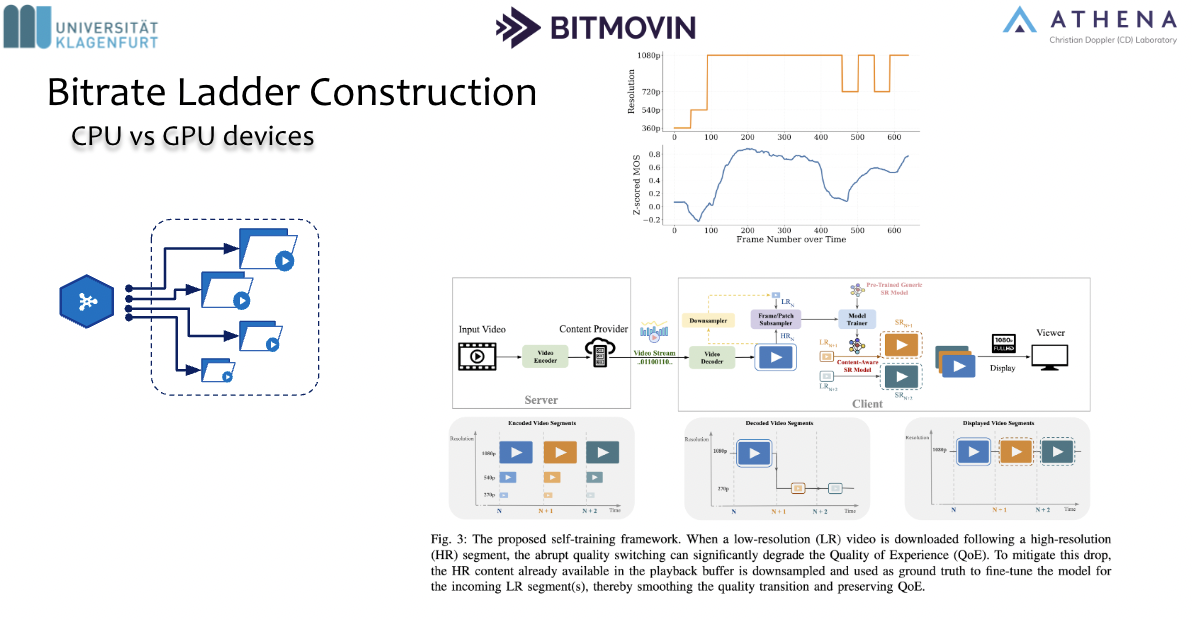
Slide from Hadi and Alodi’s presentation: Showcasing how the training is completed with reasoning
Session 2: Beyond captions with sign language avatars
The second talk, presented by Farzad Tashtarian, shifted focus from raw quality to accessibility. By 2050, almost 2.5 billion people are expected to have some degree of hearing loss, which means a huge part of the future streaming audience will rely on accessible experiences that go beyond simple subtitles. For many deaf viewers, sign language is more natural and less tiring than following fast moving text, particularly in technical or dense content.
Slide from Farzad’s presentation: Global hearing loss projections show the growing need for more inclusive video accessibility
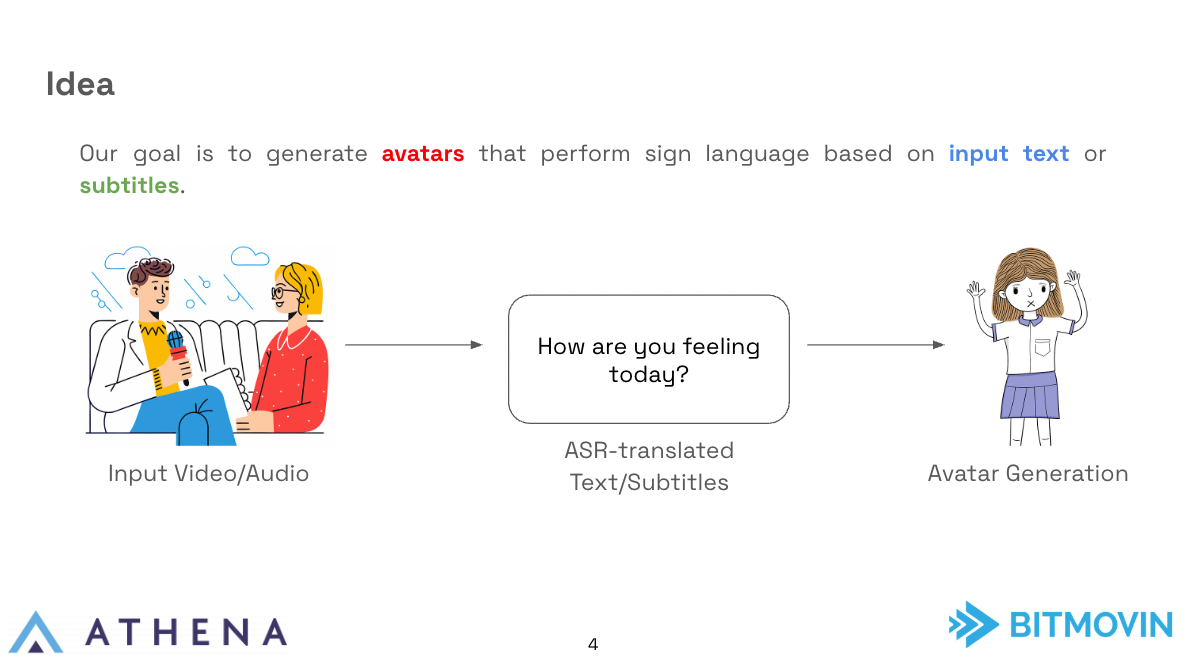
The session described a practical pipeline that starts with text already present in the workflow, such as subtitles or ASR output, and turns it into a live sign language avatar next to the video. To keep it deployable in real streaming environments, the problem is split into two questions: how to generate sign language sequences from text, and how to turn those sequences into an avatar that can be streamed efficiently. On the server, a Text to Gloss to Sign approach produces pose sequences which are converted into compact skeleton data. On the client, a generative model reconstructs the avatar from those skeletons and overlays it on the main video.
For Demuxed’s developer audience, this framing matters. It shows exactly where the heavy language work runs, what has to be computed at the server, and what belongs in the player, which makes it much easier to imagine how to integrate this into existing streaming stacks.
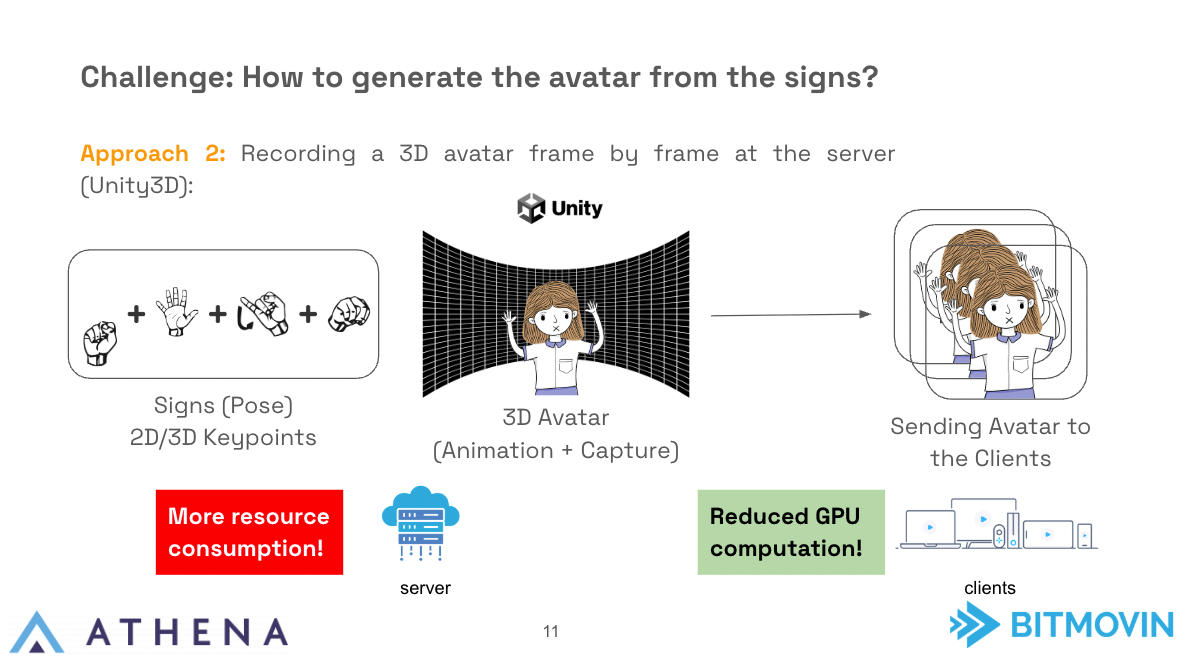
Slide from Farzad’s presentation: Shows how the Gloss2Sign model learns to convert gloss sequences into sign language avatars
For Demuxed’s developer audience, this framing matters. It shows exactly where the heavy language work runs, what has to be computed at the server, and what belongs in the player, which makes it much easier to imagine how to integrate this into existing streaming stacks.
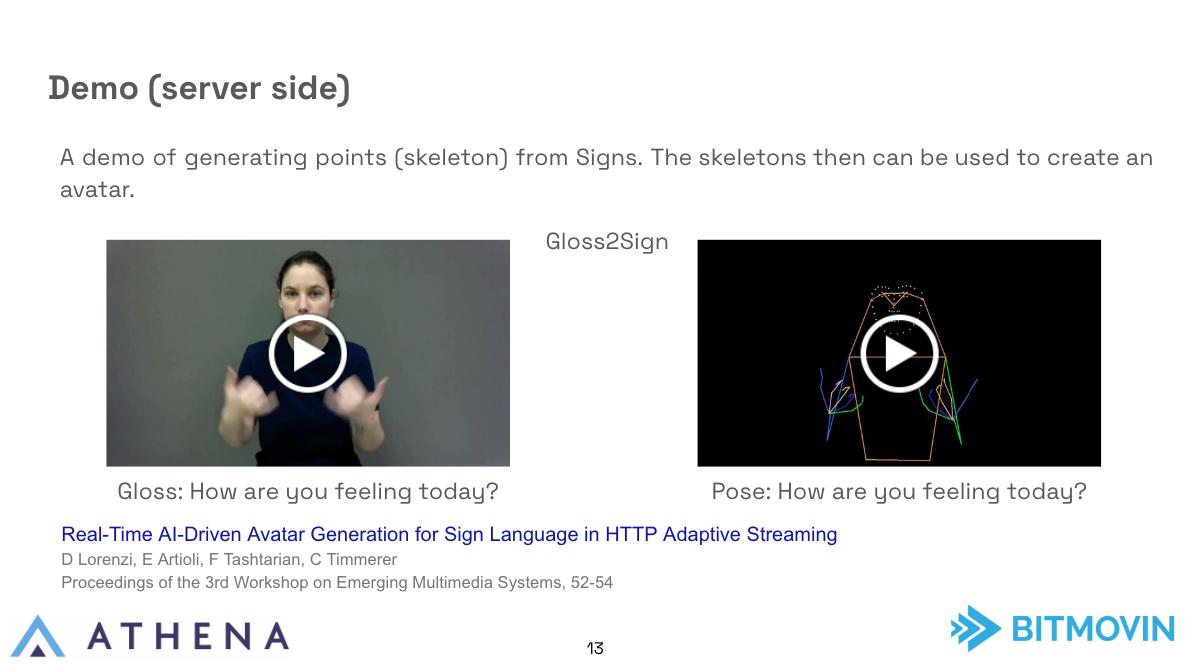
Slide from Farzad’s presentation: Visual example of transforming skeleton data into a signing avatar on the client.
It also gives developers a practical starting point. Teams can reuse subtitles they already produce today, push gloss and pose generation into a backend service, and let the player determine how to render and position the avatar. With that foundation in place, signed communication can progress from a niche experiment into an accessibility feature that evolves alongside growing audience expectation and regulatory pressure.
Bringing it back to the developer
Both talks were built for the people who sit closest to the code and logs that keep streaming platforms alive. Smarter bitrate ladders, GPU aware models and self learning players give developers new levers for quality without simply throwing more bitrate at the problem. AI generated sign language avatars show how accessibility can move beyond captions by reusing text and audio that already exist in the workflow.
Demuxed was the right place to share this work because the people in the room are exactly the ones who can turn it from research into reality. If you left London wanting to try some of these ideas in your own player or pipeline, the Bitmovin team would be happy to continue the conversation and help you experiment.
FAQs
What makes a “smart” video player in modern streaming architectures?
A smart video player leverages adaptive bitrate logic, real-time playback analytics, and device/network awareness to dynamically optimize video quality, startup time, buffering, and overall Quality of Experience (QoE). It makes client-side decisions based on runtime conditions rather than relying solely on static encoding configurations.
Why is client-side analytics important for video playback?
Client-side analytics provide visibility into real-world playback performance, including buffering events, bitrate switches, startup time, and errors. This telemetry enables data-driven optimization, faster root-cause analysis, and continuous QoE improvement across devices and regions.
What role does ABR play in delivering better Quality of Experience?
Adaptive Bitrate (ABR) streaming enables the player to switch between different quality renditions based on real-time bandwidth and performance conditions. Advanced ABR algorithms minimize rebuffering while maximizing visual quality, directly impacting viewer satisfaction.