TL;DR
- Global FAST channel count hit 2,172 in mid-2026, up 17.5% year over year.
- Programming volume is now growing faster than channel count, especially in sports.
- Roughly 46% of U.S. households with internet access now regularly use FAST services.
- The bar is shifting from launching channels to running them reliably.
- Ad execution and playback quality are becoming the same operational problem.
For much of FAST’s early growth, channel expansion was a major measure of progress. Channel counts are still climbing and existing libraries keep turning into new lineups, but launching a channel is no longer the differentiator it once was. The harder question is what happens once that channel is live and running 24/7. Reliability, ad execution, and viewer experience increasingly determine whether a channel can generate the ad revenue its business model depends on, and that is where most of the industry’s attention is starting to shift.
This piece looks at what that shift requires, from the encoding layer through to the moment an ad break plays.
What a FAST channel is
FAST stands for free ad-supported streaming television. It runs a curated, always-on schedule of live or library content, delivered over the internet the way people watch cable or broadcast TV rather than on demand.
Unlike on-demand viewing, the viewer does not need to choose a specific title before playback begins. They tune into a stream that is already playing. The platform earns revenue from advertising rather than a subscription, which removes the subscription barrier for viewers. There are no payment details to enter, no subscription to manage and, in most cases, no login required.
FAST growth is changing the operational challenge
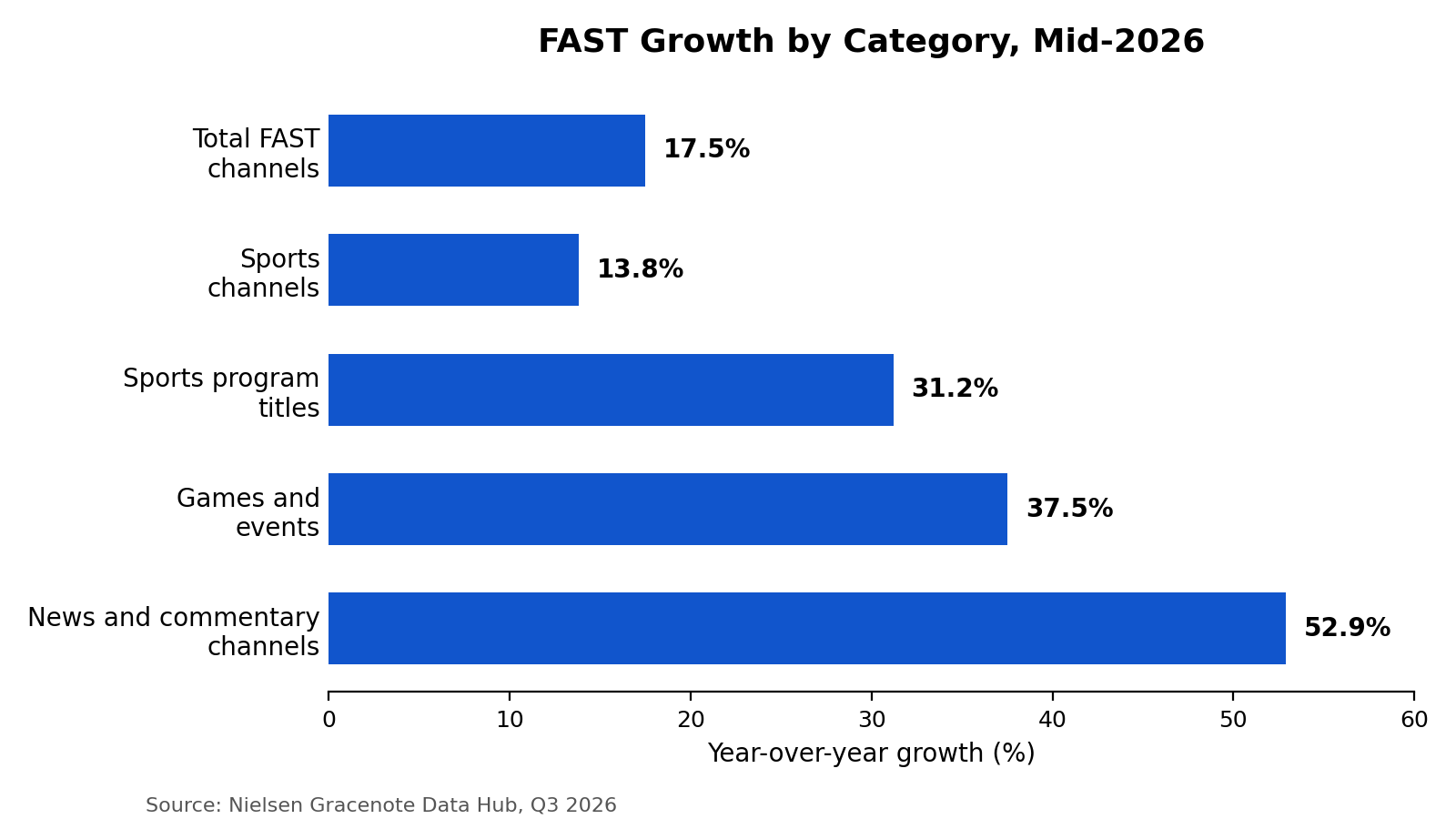
Global FAST channel count grew 17.5% year over year to 2,172 as of July 2026, according to Nielsen’s Gracenote Data Hub. Total video distribution is up 18.6% and TV program titles up 19.4% over the same period. News and commentary channels grew fastest, up 52.9%, but sports tells a different operational story. FAST sports channels rose 13.8% year over year, while unique sports program titles increased 31.2% and individual games and events climbed 37.5%. Programming volume is beginning to outpace channel growth. That matters because the technical challenge is shifting from launching more channels to reliably operating increasingly complex ones.
Cord cutting and subscription fatigue keep pushing viewers toward free alternatives. Parks Associates found that roughly 46% of U.S. households with internet access now regularly use FAST services. Advertiser adoption has not fully kept pace with that growth, according to eMarketer, a gap platforms still need to close.
That growth also puts more pressure on the infrastructure underneath it, and that pressure is not confined to the U.S.
FAST is scaling well beyond the U.S.
A pan-European study by ShowHeroes and Omnicom Media Netherlands, surveying 4,377 consumers across six markets, found 27% of Europeans already watch FAST channels, with the UK and Italy leading at 37%.
A separate Rakuten study found 73.7% of European FAST viewers watch daily or several times a week, and 80.1% consider it a main way to watch TV rather than a filler option. India tells a different kind of story, one about opportunity rather than confirmed FAST adoption. Its connected TV base grew 85% year over year to 129.2 million users in 2025, according to Ormax Media’s OTT Audience Report, and 67% of those viewers have no access to paid streaming at all, suggesting a sizable potential audience for free, ad-supported streaming models. The report measures CTV penetration rather than FAST viewership itself.
What makes a FAST channel hard to run
A FAST channel looks simple from the outside. Pick content, put it on a schedule, insert ads, done. In practice it is a live stream that never stops, stitched together from VOD assets, live feeds, and pre-produced blocks, delivered across dozens of devices and platforms at once.
Six things make it genuinely hard:
- Encoding and packaging content reliably, 24/7, with no room for downtime
- Switching sources, ad breaks, and programming blocks without a visible hitch
- Monetizing with ads without degrading playback quality
- Delivering consistent, high-quality playback across dozens of devices and platforms
- Keeping the schedule in sync with what is airing, second by second
- Treating ad signaling as part of the pipeline, not a downstream patch
Solve those well, and a FAST channel starts to behave like a broadcast network. When these workflows break down, the impact appears directly in playback quality, viewer retention, and ad delivery. In FAST, ad performance and playback performance are becoming the same operational problem. The operating question for FAST is shifting too. It used to be how cheaply a platform could launch another channel. It is becoming how reliably a platform can monetize every additional hour watched.
Turning a VOD library into always-on inventory
Many FAST channels start from an existing VOD library rather than a live feed. The more scalable approach is to prepare those assets once and reuse them across AVOD, FAST, and other monetization models, rather than building a separate encoding pipeline for every new channel. That approach is easier to scale when ad signaling is considered during asset preparation rather than added later as a separate downstream step. For contextual advertising workflows, metadata can also be generated as part of the same content-preparation process rather than through a separate content-tagging step.
Bitmovin’s VOD Encoder is one example of this pattern in practice. It inserts SCTE-35 markers during the original encoding pass and integrates with SSAI platforms like Google DAI, AWS MediaTailor, and Yospace, so the same encoding job can support AVOD, FAST, and other monetization workflows without re-encoding the source. The same workflow can go a step further with AI Scene Analysis, which runs inside VOD Encoder to generate scene-level metadata, including objects, mood, setting, and IAB taxonomy tags, giving ad decisioning systems contextual signals based on what is happening within the content. The same metadata can also support automatic highlight and clip generation, creating additional programming assets from an existing content library.
For a programmer running multiple channels from the same library, consolidating these steps into a single workflow reduces the need to repeatedly prepare assets as new channels and monetization models are added.
Live sports and continuous linear feeds need a different encoding path
Sports, news, and continuous linear feeds do not fit the VOD-first pattern. They require a live encoding path that can run continuously alongside library-based programming and support the same ad insertion logic as VOD.
Reliability becomes especially important here because an ingest failure can interrupt the live channel immediately. Bitmovin’s Live Encoder supports input redundancy to help maintain continuity if the primary feed fails, while SCTE-35 signaling can be carried through the live workflow to support consistent ad insertion.
Live-to-VOD workflows can also turn a completed live event into an on-demand asset, allowing a sports broadcast or news segment to move into VOD or FAST rotation without a separate re-encode. A channel that goes down mid-match risks losing viewers for the remainder of that event, which is why this reliability becomes even more important as sports grows on FAST.
Channel switching has to stay responsive
Viewers flip FAST channels much like they do broadcast channels. It happens quickly, often on impulse, with little patience for delay.
Bitmovin’s Player Web X is built for that kind of switching, delivering roughly 30% faster startup time than HLS.js at a smaller bundle size. Its Load Control API lets a new source, including ad content, preload its manifest or segments in the background before it is needed, so both the next channel and the next ad break can be ready before the viewer actually requests the switch. That cuts down the setup work a browser would otherwise do between a channel change and the first frame.
For FAST, that matters because even small delays during channel switching can give viewers a reason to move on, and that cost compounds. A viewer who flips through several channels before settling on one pays that setup cost every time, not just once.
Once the channel is live, you need to see what viewers see
None of the above matters if a team cannot tell whether it is working. A session can look fine on paper while the viewer watching it is struggling through buffering or a failed ad.
Visibility into live sessions, not just error logs after the fact, is what turns a channel from a black box into something a team can operate. Bitmovin’s Observability solution covers metrics such as:
- Startup and join time per session
- Buffering and rebuffering behavior
- Video quality and resolution switches
- Playback Score for overall session success
- Ad session completion across SSAI (server-side ad insertion), CSAI (client-side ad insertion), and SGAI (server-guided ad insertion)
The last one matters as much as the rest. Observability for video playback covers ad sessions alongside content performance, so a team can see whether an ad break actually completed cleanly instead of assuming it did because the stream did not throw an error. That visibility can determine whether a team catches revenue risk in the moment or discovers much later that ad inventory was not delivered as expected.
Where this goes next
FAST is not slowing down, but channel count alone no longer tells the full story. Programming volume is growing faster than channel count, especially in sports, and that raises the operational bar on every channel already running, since the platforms adding the most programming per channel also have the most to lose if playback quality or ad delivery slips. That is the throughline across encoding, delivery, and observability, where ad performance and playback performance are no longer separate problems to solve. A platform that encodes reliably, switches cleanly, and monitors every session in real time has the foundation in place. What it does with that foundation, in ad targeting, personalization, and measurement, is what will separate a FAST channel that keeps scaling from one that plateaus once the easy growth runs out.
FAST’s first phase was about expanding channel supply. Its next phase will be about increasing the value and reliability of every hour inside those channels.
Content is still what gets a viewer into a FAST channel. The experience determines whether they stay, and whether that viewing can be monetized. See how Bitmovin can support your FAST channels and start a free trial today.