
HEVC in Bitmovin’s VOD Encoder V3 cuts bitrate by 15% to 18% on average across 14 clips, and up to 24% on cinematic content.
The V3 HEVC codec matches the previous codec’s quality at 17.6% lower bitrate on a fixed ladder, or delivers 3.9 VMAF points more at the same bitrate. With Per-Title Encoding on both sides, the saving is 15.5% and the gain 3.0 VMAF points. Against a leading public cloud encoder, the gap is larger: 23.3% fewer bits than its QVBR ladder and 36.3% fewer than its automated per-title ladder. The gains are smallest on 50p and 60p television, where one clip saves 1.6%.
If you’re the engineer who has to answer whether it’s worth requalifying, this blog is for you. We’ll go into how we tested, where the gains hold up and where they narrow, and how to run the same test on your own content.
What was tested
This benchmark tests the HEVC codec in Bitmovin’s VOD Encoder V3, referred to below as “V3.” Bitmovin ran it in August 2026 on the beta. Because this is Bitmovin’s own test, the independent evidence, from Jan Ozer’s June 2026 H.264 evaluation, is covered later as a cross-check.
14 1080p clips in four content categories:
- Animation: one clip (24p)
- Cinematic: three clips (24p)
- Sports: six clips (25p, 30p, 50p and 60p)
- TV: four clips (30p and 60p)
Each clip is a mix, cut to exercise scene changes rather than a single steady shot. The four categories carry equal weight in the aggregate figures, which is how the release figures were produced; clip-level figures appear below where they add information.ion.
Six encoder arms, each producing a full ABR ladder:
| Arm | What it is | Rungs per clip |
|---|---|---|
| V3 HEVC, Per-Title | V3 codec, ladder built by Per-Title Encoding | 5 to 7 |
| V3 HEVC, static | V3 codec, fixed six-rung ladder (240p to 1080p) | 6 |
| Previous HEVC, Per-Title | Prior codec generation, Per-Title Encoding | 5 to 6 |
| Previous HEVC, static | Prior codec generation, same fixed ladder | 6 |
| Public cloud encoder, automated ABR | The cloud service’s per-title mode, default settings | 8 to 9 |
| Public cloud encoder, QVBR static | The cloud service’s quality-defined VBR on the same six-rung ladder | 6 |
Every rendition was scored on VMAF under two model versions (labeled v1 and v0 in the report), PSNR and SSIM. Each rendition also carries a per-frame VMAF distribution: mean, harmonic mean, standard deviation and the 5th percentile, which is the score 95% of frames exceed. That last number matters more than the mean for anyone who has watched a fade-to-black turn into a block party.
BD-rate is computed per clip, averaged within each category, then averaged across the four categories. For this article I recomputed every BD-rate from the report’s rung-level tables using the standard Bjøntegaard method: piecewise-cubic interpolation of log bitrate against quality over the overlapping quality range. The recomputation reproduces the published figures: 15.5% Per-Title, and 17.5% static against the release’s 17.6%. Weighting the 14 clips equally instead of the four categories gives 14.5% and 17.9%, because six of the clips are sports and one is animation. The rest of this article uses the category weighting.
One design point worth naming. Comparing static ladder to static ladder isolates the codec, because both sides encode the same resolutions at the same target bitrates. Comparing per-title to per-title, or per-title to a different vendor’s automated ladder, mixes codec efficiency with ladder construction, since Per-Title Encoding analyzes each source and selects the resolution and bitrate of every rung. Both comparisons are useful. They answer different questions, and the article keeps them apart.
Rate-distortion curves
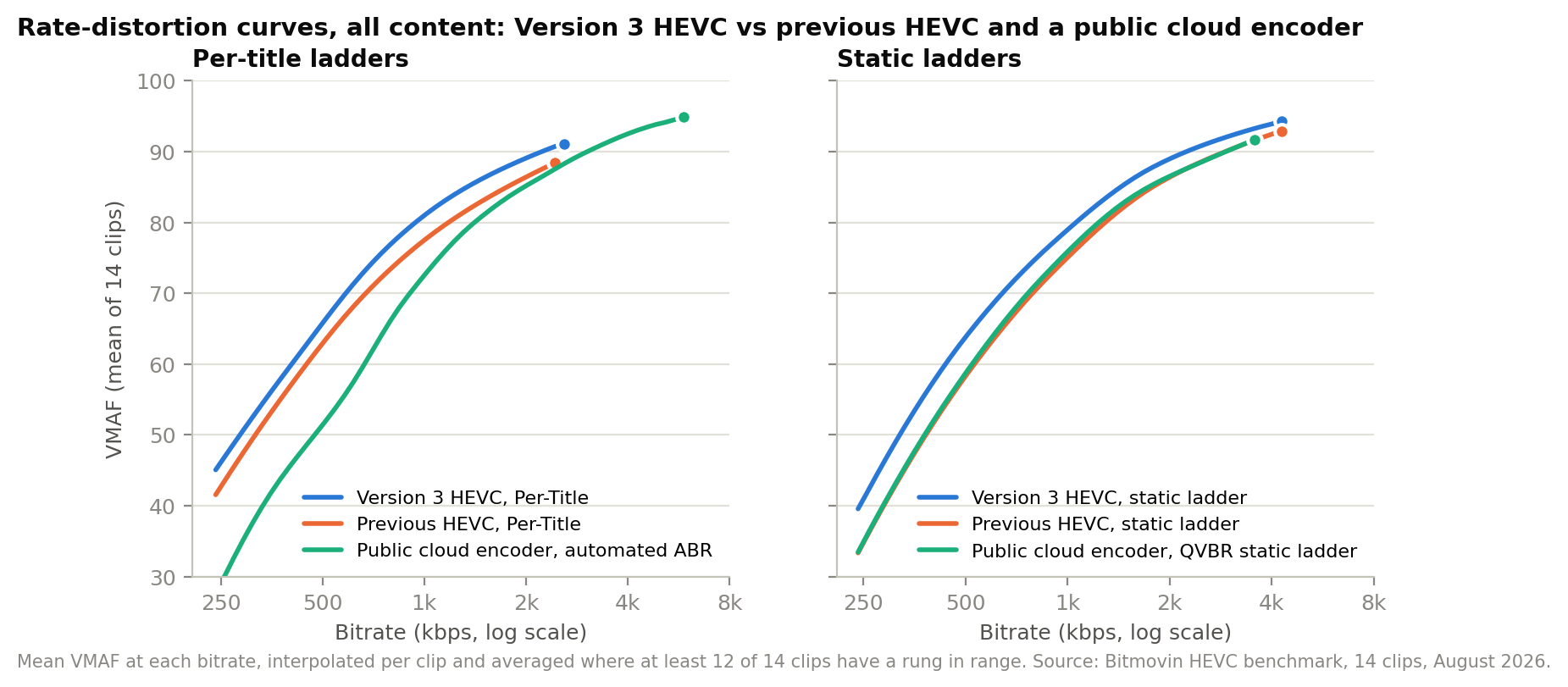
Figure 1. Mean VMAF against bitrate across the 14 clips, per-title ladders on the left and static ladders on the right. V3 sits above the previous codec across the full bitrate range in both panels.
The left panel is the fairest view of what a VOD Encoder V3 customer running Per-Title Encoding will see: the blue curve is above the orange one everywhere, by 2.8 to 3.5 VMAF points, and the gap is as wide at 250 kbps as at 1 Mbps, the range where mobile and congested connected-TV sessions live. At 1,000 kbps the mean VMAF is 81.0 for V3 Per-Title, 77.5 for the previous Per-Title, 75.9 for the cloud encoder’s QVBR ladder and 72.5 for its automated ladder. At 1,500 kbps: 86.3, 83.2, 83.2 and 81.1.
The right panel makes a point the left cannot: on identical ladders, the previous HEVC codec and the cloud encoder’s QVBR are nearly the same curve. The cloud encoder’s QVBR is 1.9% more efficient than the previous static ladder on VMAF. The gap you see in the release is a V3 gap, not a legacy one. If you evaluated Bitmovin’s VOD Encoder in 2025 and found parity with your cloud encoder, that result reflects the previous codec, not V3.
BD-rate by metric
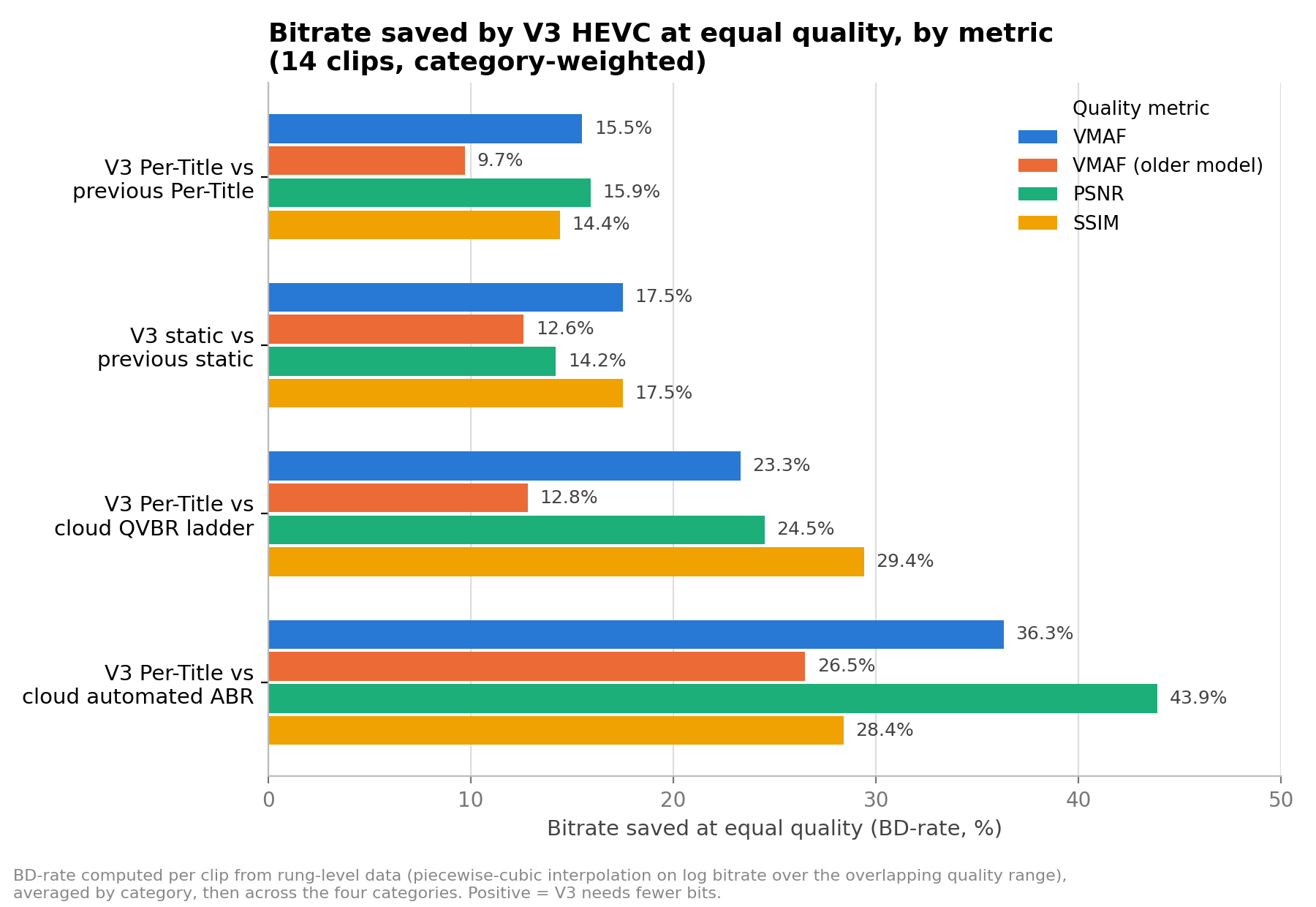
Figure 2. Bitrate saved by V3 at equal quality, for four comparisons and four metrics. Positive means V3 needs fewer bits.
Read the top two groups first, because they are the codec-versus-codec numbers. Against the previous codec, V3 saves (Per-Title against Per-Title, then static against static):
- VMAF: 15.5% and 17.5%
- PSNR: 15.9% and 14.2%
- SSIM: 14.4% and 17.5%
- Older VMAF model: 9.7% and 12.6%
Four metrics, one direction, and PSNR lands within half a point of VMAF on the Per-Title comparison and within 3.3 points on the static one, which is the pattern you want when a codec is tuned for perceptual quality rather than for a single metric.
The older VMAF model is the conservative case. If your internal quality gate still runs that model, plan on 10% to 13% rather than 15% to 18%. The direction does not change.
The two cloud-encoder comparisons are larger and noisier, for a reason the next section shows.
By category and by clip
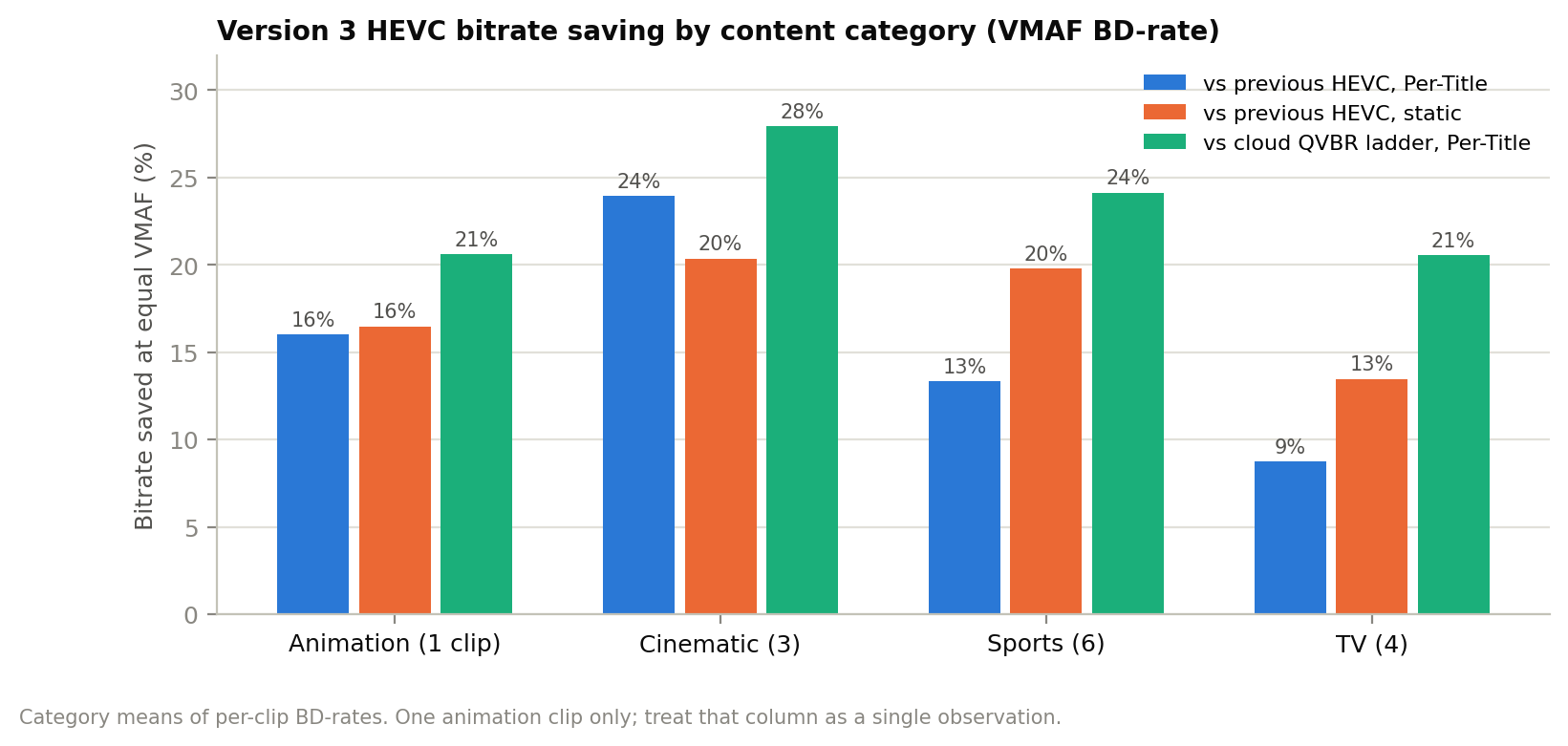
Figure 3. Bitrate saved by content category. The animation column is a single clip.
Cinematic content gains most: 23.9% Per-Title against Per-Title, 20.4% static against static. Sports gains 13.3% and 19.8%. TV gains least, 8.7% and 13.5%. The animation figure, about 16% under both comparisons, rests on one clip and should be read as one observation.
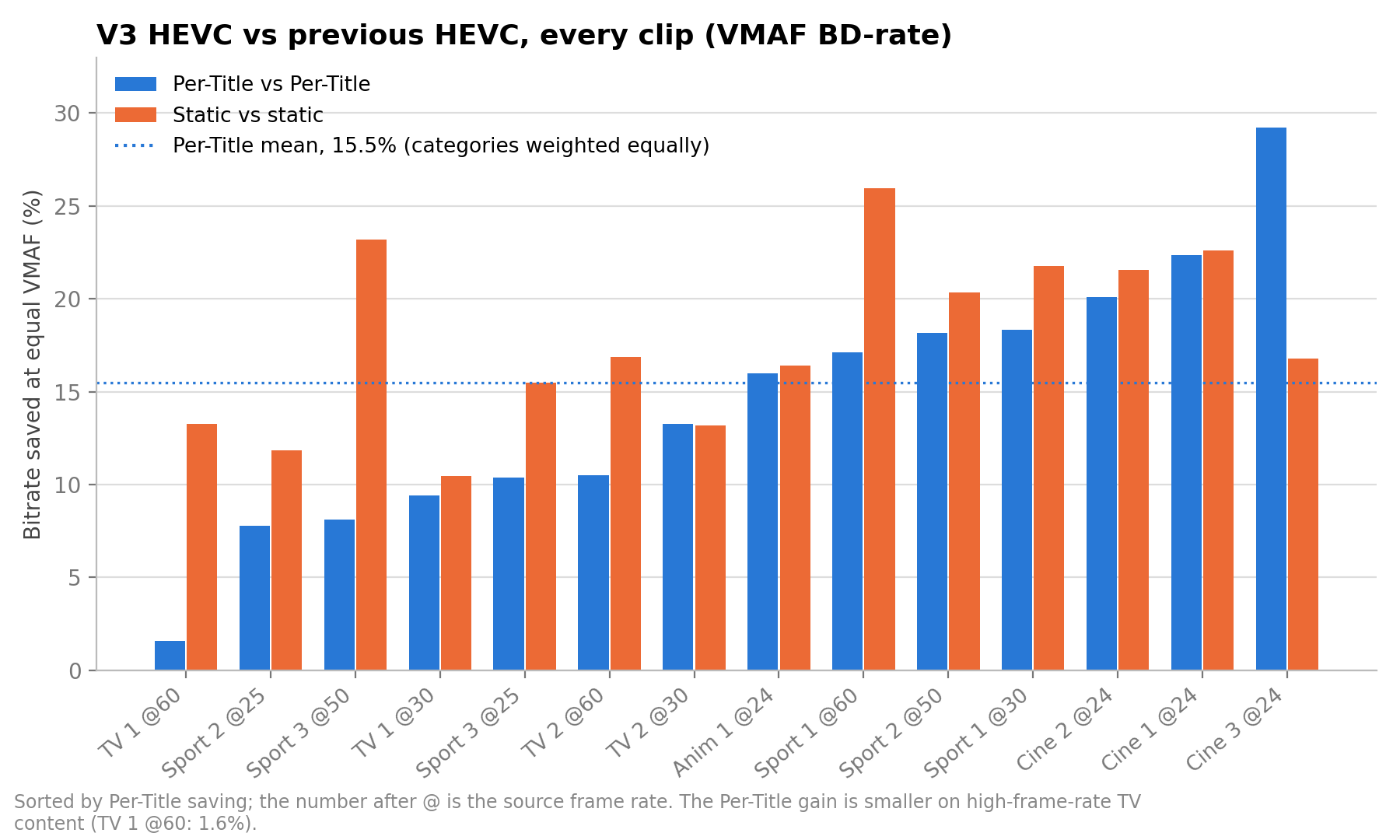
Figure 4. Every clip, sorted by the Per-Title saving. The number after @ is the source frame rate.
What stands out at clip level:
- Every one of the 14 clips saves bitrate under both comparisons; there is no clip where V3 loses.
- The Per-Title gain is smaller on high-frame-rate TV content. TV 1 at 60 fps saves 1.6% Per-Title (13.3% static).
- Across the five clips at 50 or 60 fps, the Per-Title saving averages 11.1%, against 16.3% for the nine clips at 24 to 30 fps. The static comparison does not show this split: 19.9% at 50/60 fps, 16.7% below.
The likely explanation is that the previous Per-Title already made conservative resolution choices on high-motion, high-frame-rate content, leaving less for the V3 codec to recover through ladder shape.
Worst frames and the top rung
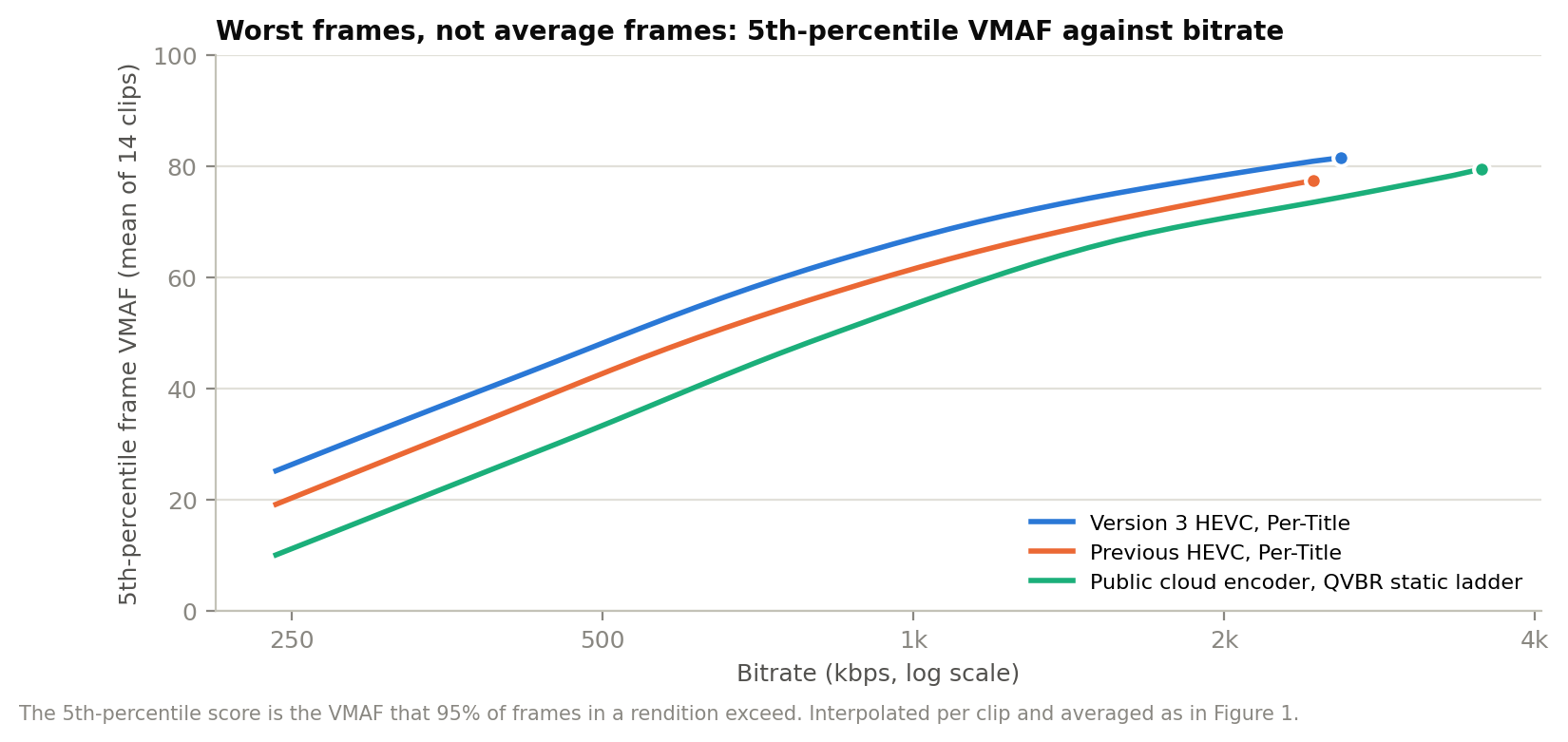
Figure 5. 5th-percentile frame VMAF against bitrate for the per-title ladders and the cloud encoder’s QVBR ladder.
Mean VMAF hides the frames viewers complain about. The 5th-percentile curve tracks the mean curve here, which means V3’s gain is not bought by letting hard frames go. At the top rung, the mean 5th-percentile score across clips is 84.3 for V3 Per-Title against 81.0 for the previous Per-Title.
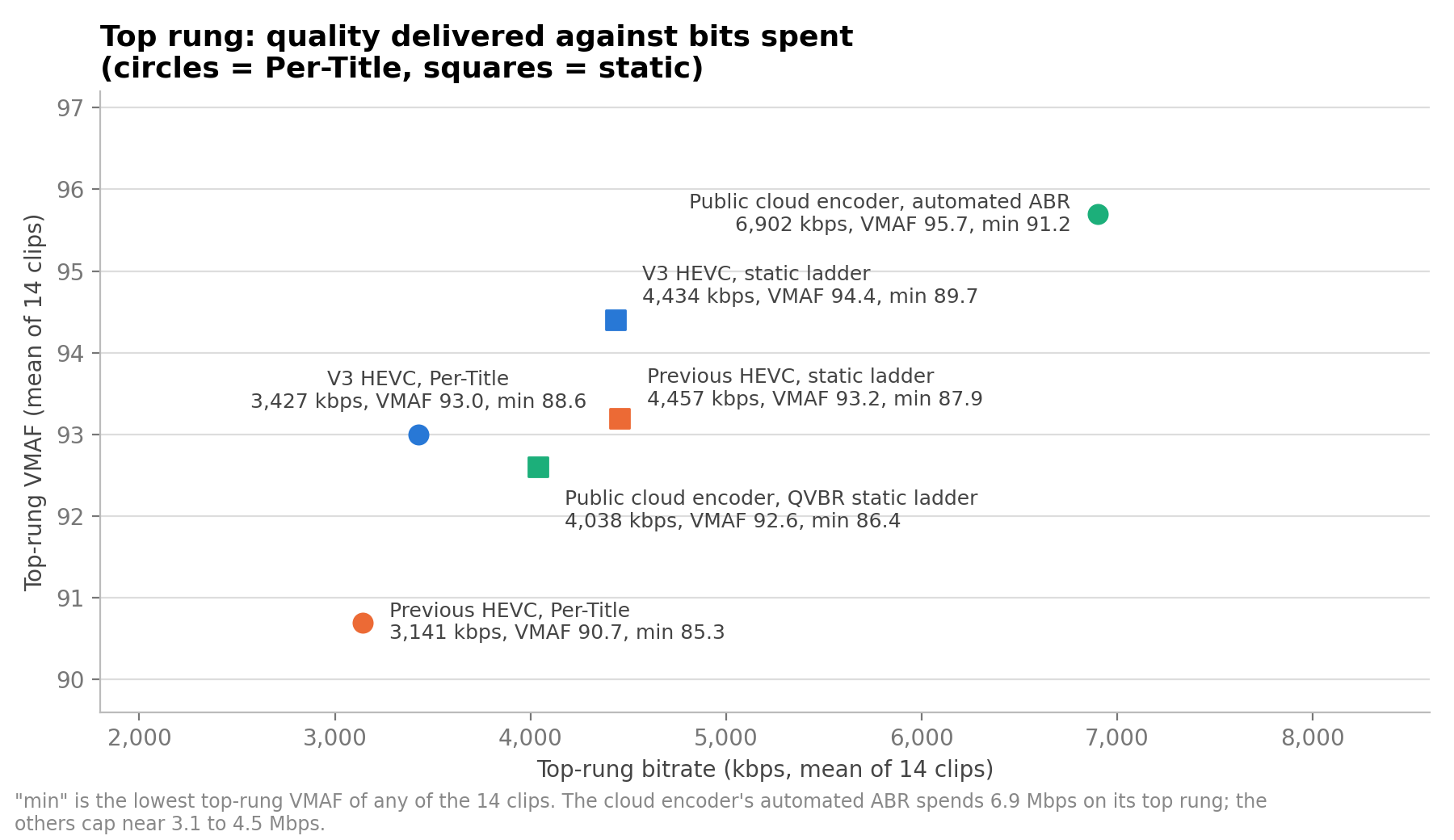
Figure 6. Top rung of each ladder, mean across clips: bitrate spent against VMAF delivered. “min” is the lowest top-rung VMAF of any clip.
The top rung is where most premium viewing lands and the only rung with a widely agreed quality target. V3 Per-Title’s top rung averages VMAF 93.0 at 3,427 kbps, with a worst clip of 88.6. The previous Per-Title averaged 90.7 at 3,141 kbps, worst clip 85.3. It spends 9% more bits at the top rung and delivers 2.3 VMAF points more, with the worst clip up 3.3 points. V3 static reaches 94.4 at 4,434 kbps. The cloud encoder’s automated ladder reaches 95.7, but spends 6,902 kbps to get there, which is the first clue to the 36.3% gap.
Ladder construction is not codec efficiency
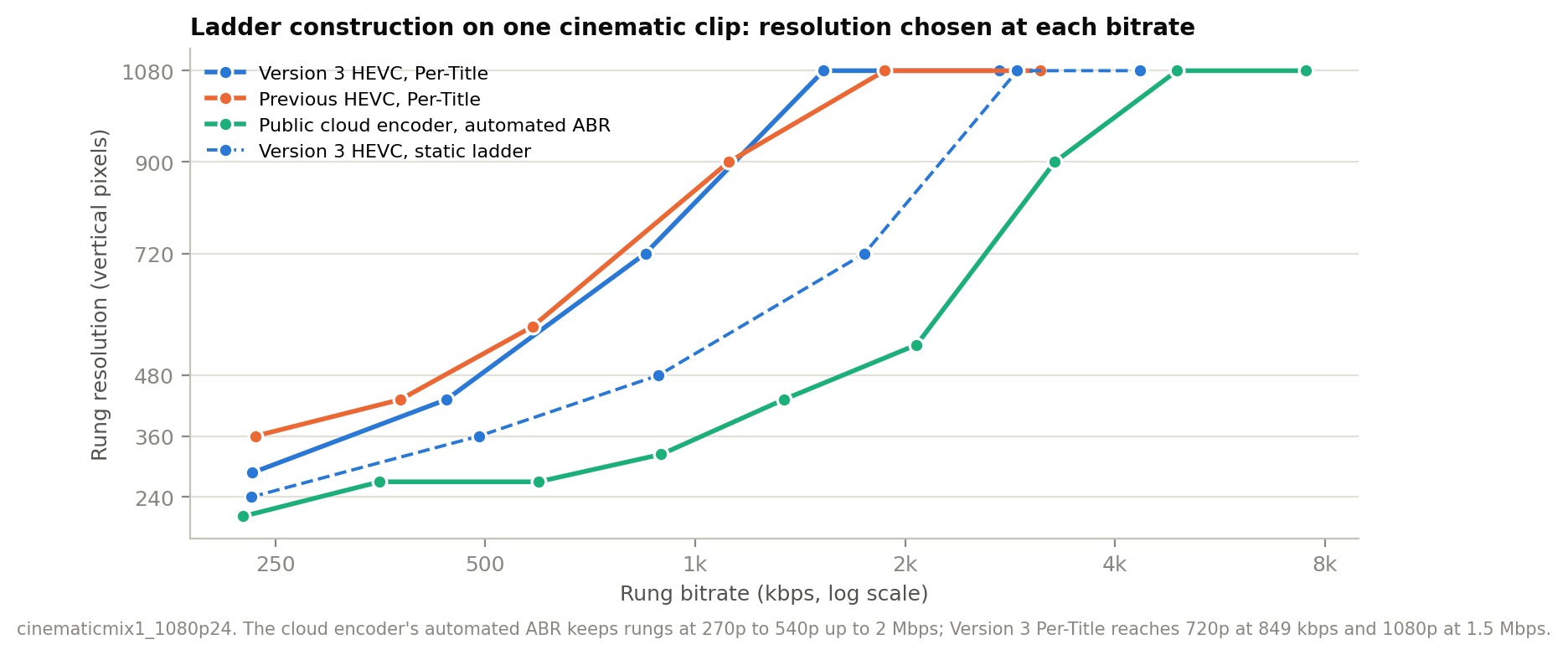
Figure 7. Resolution chosen at each rung bitrate on one cinematic clip. The cloud encoder’s automated ladder stays at 432p or below until 2 Mbps.
Why does V3 Per-Title beat the cloud encoder’s automated ladder by 36.3% on VMAF, when it beats the same encoder’s QVBR static ladder by 23.3% and the codec-only gap (static against static) is 16.3%? Because the automated ladder makes conservative resolution choices. On cinematicmix1, it holds 270p until 600 kbps, sits at 324p at 894 kbps and 432p at 1.3 Mbps, reaches 540p only at 2.1 Mbps, then jumps to 900p at 3.3 Mbps and spends 4.9 Mbps and 7.5 Mbps on two 1080p rungs. V3 Per-Title reaches 720p at 849 kbps and 1080p at 1.5 Mbps. Low resolution at moderate bitrate scores poorly on every metric, and the automated ladder’s extra top rungs raise its storage without raising the quality a viewer at 2 Mbps sees.
Which comparison should you quote internally?
- If you run a fixed ladder today and would keep it, quote 16% to 18%: that is the codec.
- If you would let each system build its own ladder, quote 23% against a quality-defined static ladder and 36% against the automated ladder, and say which one you mean.
The release’s “58% more bitrate” describes the same measurement from the other side: the cloud encoder needs about 1.57× the bits (1 / (1 − 0.363)).
An independent cross-check: H.264, June 2026
In June 2026 Jan Ozer ran an independent evaluation of Per-Title H.264 in Bitmovin’s VOD Encoder against the same public cloud encoder’s automated ABR, using an FFmpeg x264 convex-hull ladder as the theoretical optimum. Fifteen clips in five categories; thirteen in the quality comparisons after the cloud encoder dropped 60 fps sources to 30 fps after the second or third rung. The full report, which names the encoder, is available on request.
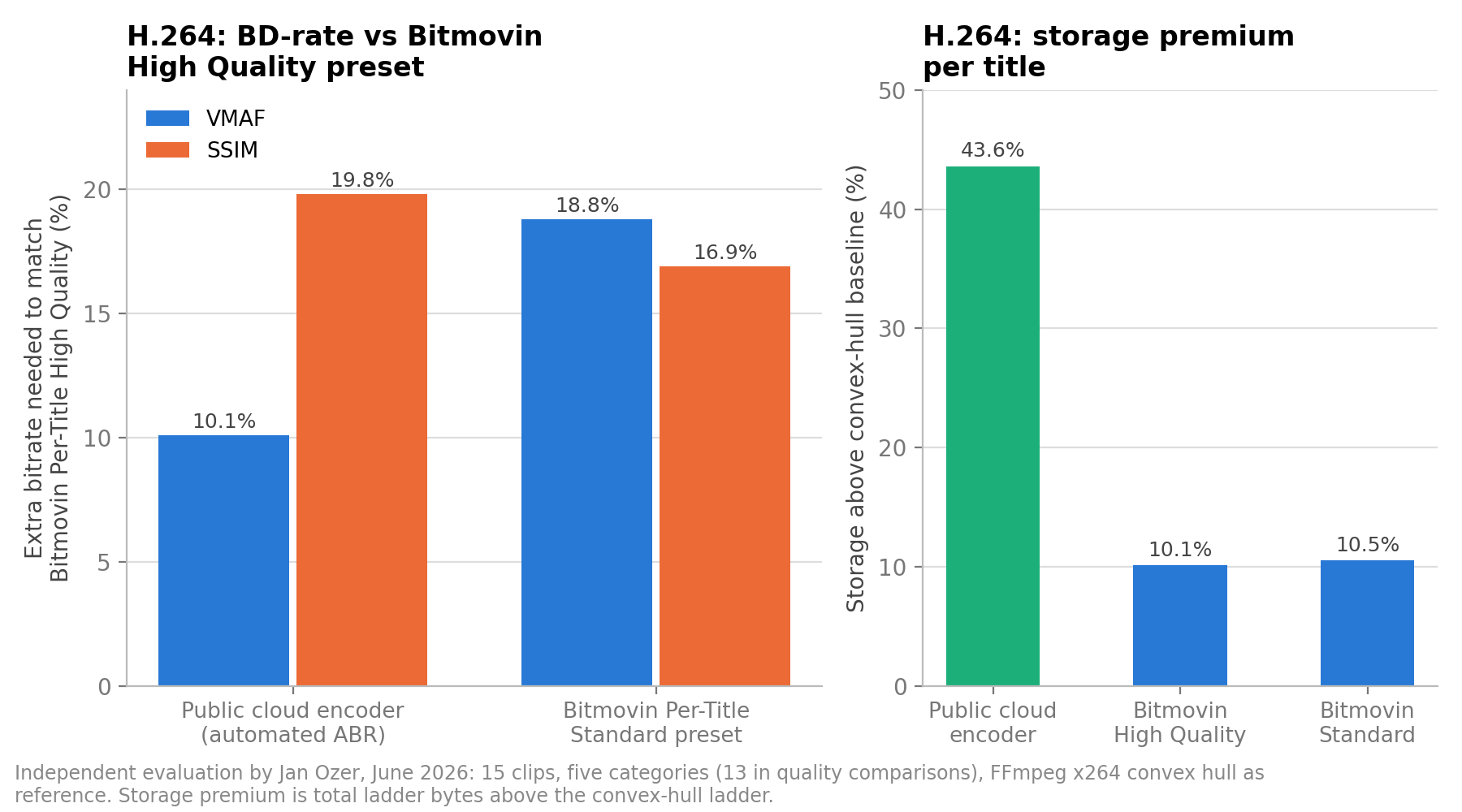
Figure 8. Left: extra bitrate the cloud encoder and Bitmovin’s Standard preset need to match Bitmovin’s High Quality preset. Right: storage above the convex-hull baseline.
The report’s findings on the cloud encoder:
- It needed 10.1% more bitrate on VMAF to match Bitmovin’s High Quality preset.
- It needed 19.8% more bitrate on SSIM.
- Its ladders carried 43.6% more bytes than the convex-hull baseline, against 10.1% for Bitmovin.
- That is because it produced 118 rungs across 15 titles where Bitmovin produced 94, with 33 rung pairs spaced closer than the 1.5× Apple guideline.
- Seven of its 15 top rungs were encoded at 720p.
Of the three commercial encoders tested, Bitmovin High Quality’s top rungs averaged the highest VMAF (92.8) with the lowest standard deviation across titles (3.3) and the highest worst-title score (85.0).
The same report is candid about where the cloud encoder wins: it was the fastest on two-minute clips (3:52 against 5:17 for Bitmovin Standard and 10:26 for High Quality) and the cheapest to encode ($13.27 per hour of content against $15.29 and $53.82). Choose it if encoding cost per output minute is the only line you are measured on and each hour of content accumulates fewer than about 7,900 viewing hours on a top-heavy profile; below that, at $0.02 per GB delivered, the lower encoding bill outweighs Bitmovin High Quality’s bitrate saving.
The two tests were run by different people, on different codecs, two months apart, and they show the same shape: Bitmovin’s ladder tracks the optimum more closely and the cloud encoder’s resolution choices cost it quality at every mid-ladder bitrate. The content where the gap is widest differs (cinematic in the HEVC test, news and enterprise in the H.264 test), which is one more reason to test your own catalog..
What changed in VOD Encoder V3
VOD Encoder V3 has been in beta since IBC 2026, with general availability planned for fall 2026. The HEVC results above come from the V3 codec generation, and two other changes bear on how you would run this test yourself:
- Real-Time VMAF (RT-VMAF) scoring is built into the pipeline for H.264, HEVC and AV1, and the release removes the separate charge for quality metrics, so the per-rendition scores in this article are the same numbers your own jobs will emit.
- A Bitmovin MCP server gives read-only access to encoding jobs from Claude, ChatGPT, Cursor and GitHub Copilot: list jobs, inspect parameters, explain failures.
To reproduce the comparisons:
- Static ladder: create two encodings of the same source with identical rung targets, one using the previous HEVC configuration and one using the V3 HEVC configuration, enable RT-VMAF on both, and compare per-rendition scores.
- Per-Title: replace the fixed ladder with a Per-Title configuration on both sides and let each build its own.
The release’s figure of 25% less cloud compute time on average comes from a separate measurement and should be verified on your own jobs.
Limitations
The numbers above come from a controlled test built to compare codecs on equal terms, and that design has boundaries. Some of the points below narrow where the results apply, and others are simply things this test did not set out to measure. Keep both in mind before you quote the numbers internally:
- Fourteen clips is a small sample, and one category has a single clip.
- The HEVC benchmark was run by Bitmovin, not a third party.
- The gain under the older VMAF model is 10% to 13%, not 15% to 18%.
- On 50 and 60 fps television, the Per-Title gain can be small; one clip shows 1.6%.
- Encoding runtime was not measured in the HEVC benchmark.
- The independent H.264 evaluation predates VOD Encoder V3 and tested the previous encoder’s presets, so it validates the ladder construction and Per-Title behavior, not the V3 codec.
- No subjective viewing test was run.
- AV1 results are not covered here.
- VOD Encoder V3 is in beta; parameter names may change before general availability.
Run it on your content
The gains in this benchmark vary with content. With Per-Title, a catalog that leans toward sports or TV should expect a saving below the 15.5% average, while one that is mostly film and drama may see more. The setup is simple enough to run in-house:
- Bring 10 clips from your own catalog, including your hardest 60p sports and your darkest drama.
- Run the static-ladder comparison first: it isolates the codec, so it’s the cleanest number to take to your team.
- Budget one business day for encoding and scoring them on two configurations.
Existing customers can request access to the VOD Encoder V3 beta through their account team. New teams can start a free trial here and ask for the beta.
Sources
- Bitmovin HEVC benchmark, 14 clips, six encoder arms, report generated August 30, 2026 (Bitmovin, internal; rung-level data as captured August 31, 2026).
- Jan Ozer, independent H.264 per-title comparison of Bitmovin’s VOD Encoder and a public cloud encoder, June 2026 (available on request).
- Bitmovin, Encoder V3 announcement, September 10, 2026, as reported by Sports Video Group, TVBEurope and TV News Check.